Skin and Bone
Katherine Brown Weissman
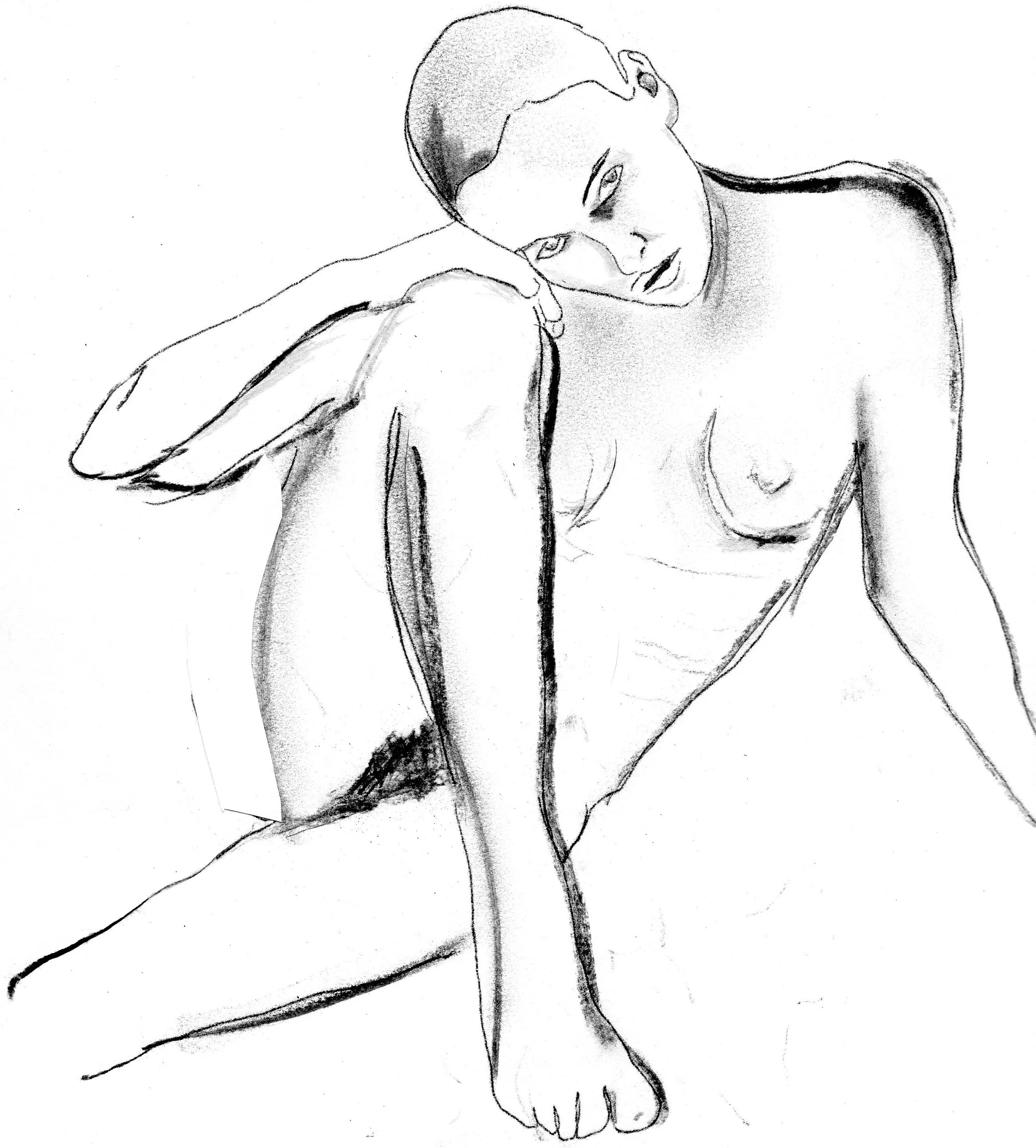
R. Johnson
Word Count 1934
All my life, the scale has been a dictator, squatting ominously in the bathroom. I step on, naked, as if a mere stitch could warp the result. I hold my breath, and the number appears. Am I safe from fatness, or does fatness loom? If the result isn’t “right,” it will stamp the whole day, the whole week; it will mark me forever.
Today the number is 99, and the message is safe.
Except that’s not true. I am anything but safe. 99 means that I have lost 20 pounds in the last six months. 99 means that I am bloated in the abdomen, flattened in the breasts, with arms and legs as skinny as a teenage girl’s or ballerina’s. The parts don’t fit together.
99 means that I have a diagnosis of pancreatic cancer and my tenth chemotherapy session is today.
And still, that number, 99, was a relief. I’d promised my doctor a weekly weigh-in—I think she was afraid I’d lose too much—and up to now, it’s been stable. I smiled when I saw 99. If it had been 102, I would have felt dismayed. I would have felt “fat.”
I know that it is ridiculous to give any weight to my weight. I am in the middle of an invasion, or maybe it is more accurate to call it an occupation. There’s a cancer monster inside me, a gargoyle like those twisted stone presences that crouch on the flying buttresses of Notre Dame. It’s starving me, poisoning me, an alien interloper that feeds straight into my whole wretched history of body hatred.
Let’s go back. Somewhere between the ages of eight and twelve, I went from being lithe and tomboyish to tubby and sullen—I’ve seen the photos. The light went out of my eyes. I squinted. I got an unfortunate permanent wave. My waist vanished. Girls’ sizes didn’t fit. My mother resorted to buying me clothes in a women’s 14.
Once junior high began, I clamped down. You might say that I installed a height-weight chart and a calorie counter in my brain. Through relentless exercise and disordered eating, I shaped the envelope of flesh I inhabited. If the control slipped—during my year in a college dorm, I lived on mac and cheese—I was horrified. My body became a battlefield. I actually felt violent, as if I could bash the pounds out of myself with my fists.
As I aged, this crazy second self became more and more entrenched. Yet my closest friends, my co-workers, even my husband and stepchildren didn’t know the true extent of my obsession. Partly this was because modern culture rewards tiny portions and underweight bodies; at the women’s magazines where I worked as an editor, being slim was practically a job requirement. But partly it was because it made me feel cool, disciplined, in control—the very opposite of the greedy monster I imagined would take over unless I watched my dietary step.
You might recall how, in Bridget Jones’s Diary, she would take note of her weight with each entry. Losing 20 pounds was her goal, but in the meantime she (and I) lived in a mode best described as dietary/defensive—as if an enormous, devastating weight gain were just around the corner and could strike without warning. To turn fat overnight: What could be worse?
A lot of things, it turns out. Unstoppable stomach pain, agonizing nausea, a blur of days in the hospital. The shock and humiliation of finding out you have cancer via a test result on your smartphone (never look at those unless someone, doctor or civilian, is on hand to catch you). Now I’m the anti-Bridget, or I ought to be. It’s nuts to go by those old rules, to cling to those neurotic aspirations. The rogue cells have made my body go haywire, and it will weigh what it weighs, and there is damn all I can do about it.
Because chemotherapy makes my mouth sore and food taste odd, I can no longer tolerate the crunchy low-calorie stuff that used to be, as it were, my daily bread (broccoli with brown rice from the Chinese takeout menu, sushi from the Japanese restaurant, salad and more salad). Instead, the mandate is to take in as many calories as possible, no matter what form they come in: These days, it’s usually smooth, sweetish stuff like ice cream, mashed potatoes, avocados, pasta. I eat the inside of bread and waste the crusts. I ease the passage of my numerous daily pills with spoonfuls of KozyShack chocolate pudding, a soft-diet hospital staple. Before this, I never ate dessert.
Before this, I mistrusted sensuousness and radiated discipline, and not just in the realm of food: I wore a lot of black, boxy clothes and let my hair be as thin and frizzy as it liked. Lately, though, I’ve begun to feel I’m entitled to have more fun. As my “scanty” hair morphs into “unmistakably balding,” I’ve learned to wind gauze wraps around my head; as my pants get so loose they fall off, I accessorize to the hilt with frilly see-through socks, dangly earrings, long scarves. I’ve taken to wearing a couple of hamsa pendants to keep myself safe.
That word again. Thin is safe when getting fat seems like the worst thing in the world. But when you have cancer, thin is no longer safe.
A week later: 98. I feel mingled worry and triumph. This morning, before I stepped on the scale, I thought I’d have gained since the last weigh-in. Partly that’s because the weight loss, instead of making me flat and narrow all over, merely redistributes the fat, turning my legs and arms into model-thin sticks and depositing any remaining poundage in the middle of my body. There, it swells into the shape of a pot or vase—like those small, dumpy fertility goddesses from 30,000 years ago found at archaeological digs. (This is such a common side effect of chemotherapy that a nurse once asked on the phone, nonchalantly, when I mentioned being bloated, “How many months?”—meaning, how pregnant did I look?) I call my stomach bad names—tubby, bulging, thick—rather than good names, such as curved or rounded. Unkindness to my body is a habit that’s hard to break, even under these radically altered circumstances.
And soon, this much-changed body will doubtless change again, as I begin radiation therapy. I will be lit up. Electrified. Targeted. Seared.
These are images different from chemo, which is insidious and poisonous. Radiation is an invader, too, but more missile than occupier. Launch, launch, launch. I see Ed Harris in his vest at Mission Control in the Apollo 13 movie. My experience with chemo has been like a nineteenth-century novel, complete with Dickensian emergency wards and hospitals, segueing into pill rituals and chamber pots and rubber tubing, and consolatory nurses you could imagine as Victorian-era angels, with vast wings. Radiation therapy could be from the Marvel universe.
Meanwhile, I still have another couple of chemos to go. Another week passes, and I feel the dread, way down in my gut, as I prepare to weigh in at home before my eleventh session. It’s been only seven days since I clocked in at 98 (I tell myself). There’s nothing to fear.
And then the number comes up: 104.
What? I feel blindsided. The scale must be wrong, except it isn’t. That angry, fat feeling returns, horribly familiar. I clutch at the flesh of my stomach. I hurtle back through the decades to the plump pre-teen in an elastic-waist poodle skirt, the college girl who gained the Freshman 15, the ballet student with a camouflaging sweater around her waist, the middle-aged obsessive who diets before her doctors’ appointments and refuses to get weighed with her shoes on.
Well, what did I think was going to happen when I ate those mega-calorie foods I’d never before allowed to enter my mouth? When I had smoothies instead of skim milk, spaghetti rather than salad, gobs of peanut butter, ice cream whenever I wanted? To be honest, I was starting to enjoy being “bad” about food. Eating too much of the wrong thing was a pleasure I had never tasted. The satiny slick of ice cream on my tongue as I scooped out a Dixie cup of coffee Häagen-Dazs! The sweet, melting bite of the chocolate bar I broke off in the theatre—for the first time ever—as an intermission snack! I always used to check calorie counts and portion sizes on a package; lately, I’d been ignoring that information, flouting my own rules. And now I was getting my comeuppance.
104. It’s flashing, red and outrageous, in my head. I guess I’ll have to say the number out loud at my appointment with the oncology nurse later today. I will feel ashamed, as if the number revealed a sort of moral failure. I will find it hard to tell it straight, without hinting at my displeasure, without making ironic remarks. “I’ve always had a lousy working relationship with my body,” I’ll say, as if a joke will strip the scale of its power.
The nurse will be pleased, I’m sure. To her, the increase in poundage is a sign of health. Why isn’t it to me? After all, 104 is still quite a bit lower than my Former Normal of 120 or thereabouts. Even though most scales are digitized now, I remember all too well the metal contraptions of my girlhood, the little sliding weight inching upward as I watched and cringed. The loss of control rattles me. Was it the thickly spread cream cheese? the giant peanut butter cookie? the burden of a few days’ constipation?
104, 104. How could I? Secretly, I am already planning to go back to skim milk; take my pills with water rather than pudding; reduce my ice-cream intake to one, not two, Häagen-Dazs mini-cups per day. And I know I will be as “chuffed” as Bridget Jones if by the next weigh-in the number on the scale has at least dropped or, even better, plummeted.
Sadly, most women I know, whatever their actual weight, are familiar with this split between the rational and the primitive. The topmost Russian matryoshka doll is a well-read feminist who knows better than to identify thinness with health, virtue, and happiness, but hiding inside her is a succession of small, furious dolls to whom that wacko body image makes perfect sense. How can I compete with an adult self who weighed 99 pounds? That was the impossible dream, made possible by an awful diagnosis. Now, it seems an indignity that I still have the disease but not this “ideal” weight! It’s as if the cancer gods reneged on their part of the deal.
So what awaits me? I hate essays that end with rhetorical questions—it seems evasive, even lazy—but you may need to put up with a few. There’s an entry for body dysmorphic disorder in the diagnostic manual, the shrinks’ bible, but there’s no checklist for the cancer patient who’s trying to establish a new sense of normality. First, I’d have to stay alive, which is not something I can take for granted (I’m 80 years old, and the survival stats for pancreatic-cancer patients are not encouraging). Second, I’d require enough downtime—a break from constant exams, scans, treatments—to remember what ordinary life is like. Third, I’d need to weigh…what? Doesn’t thinness or fatness seem utterly irrelevant in this life-or-death moment? Doesn’t the tyranny of the scale need to stop right now?
The twelfth chemo, my last, is coming up. Wish me luck.
Katherine writes essays and fiction. She is a retired magazine editor and writer (Mademoiselle; O, the Oprah Magazine) as well as an ardent dabbler in other arts: drawing and painting portraits, playing the piano, taking ballet class. Her website, katherineweissman.com, contains old-but-still-worthy essays and blog posts, as well as links to published work.