The Miscarriage
Olivia Clement Finch
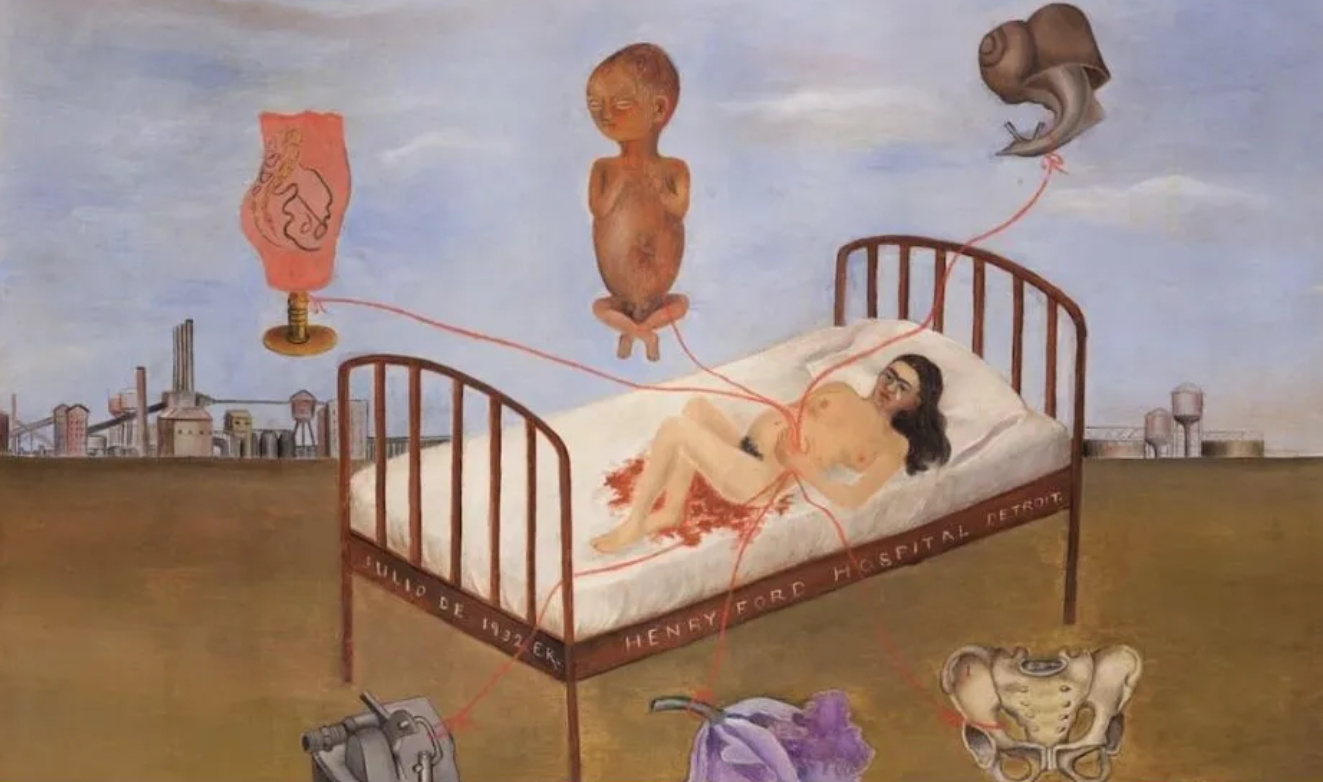
Frida Kahlo, The Henry Ford Hospital 1932
Word Count 1248
It was evening and I walked along the beach, alone. We’d come to the Dominican Republic to enjoy ourselves, to escape the monotony of our grief and we had, gotten away, temporarily. Massages and pina coladas, sex in the jacuzzi, a flamboyance of flamingos outside our window that made us snort with laughter each time we saw them. But it was our last night, and everything catches up, eventually. We’d argued at dinner, about what, I can’t remember, but I know that we both walked away angry, my husband towards the hotel room and me in the direction of the ocean. I looked up at the moon. I could see its reflection on the water, like a path, and so I followed it, stepping out of my dress and into the soft waves. It was surprisingly warm, on my thighs, my hips, my belly. I clenched and unclenched my fists. I slipped my head under the water and opened my eyes. Heal me, I whispered, to nobody. I could still see the moon, under the surface of the water.
I was angry at my body. This body that had tricked and failed me. Two months earlier, I’d lost a baby. At my eleven-week check-up the doctor had searched for the heartbeat on the surface of my abdomen but found only the sound of the ocean. The muffled sounds of blood rushing, of my organs working. It was called a missed miscarriage, she told us. When the baby’s heart stops beating but your body continues to show signs of pregnancy. I looked at the creature on the ultrasound. He felt far away, like somebody else’s baby. The doctor explained that I was at risk of an infection, and that the fetus would have to be removed surgically.
That afternoon, I drove to the woods on the edges of Iowa City. I walked fast, without stopping, up hills and over roots, and through the long grass in the clearing. It was fall, and the deer were out. They watched me, carefully, through the trees. Some were pregnant, their fawn due in the spring. I’d learned this when I was pregnant. I passed a man who was talking on the phone. It’s just a naked man running, he was saying, and the whole thing is in Inuit. It seemed absurd to me that people were out in the world, laughing and talking about art.I pictured the baby slowly rotting in my uterus. I walked faster, urging time to move forward. I walked for hours.
Throughout my pregnancy, I’d walked in these same woods. This is where I would talk to my baby. I told him that the world was in turmoil, that we were still in a pandemic, but that I couldn’t wait to meet him, to show him what true love was, and true care. These conversations made me feel hopeful. At some point, though, I’d started to feel anxious. My symptoms would come and then go in a way that no longer felt normal. I watched the leaves start to turn brown and fall, filling the path beneath my feet. I wanted to trust my body, to trust that everything was as it should be.
Five days after the surgery, my husband and I flew to New York City, where we’d met and gotten married. We booked an expensive hotel in Downtown Manhattan and made a reservation at a restaurant where I’d always dreamed of going. I wore red lipstick and ordered a martini. It was a cool evening, but I felt hot, and a little nauseous. During dessert, I started cramping. We went back to the hotel, where I passed large clots of blood into the toilet. The doctor had prepared me for this. It’s natural, she’d said. You’ll bleed a lot, even after we’ve removed the fetus. Still, I was confused by what came out of me. I held a clot the size of my palm under the bathroom light; it looked like something from deep in the ocean. I spent the night looking out of the window, at the tiny people walking along Sixth Avenue.
Back in Iowa, I returned to the acupuncturist that I’d seen while I was pregnant. It had been weeks since my miscarriage. My back was covered in acne and I was still crying every day, still bleeding. I need help, I told her. It’s a very lonely grief, she responded. I nodded and pressed my lips together so that I wouldn’t cry in her office. Alone, with the needles in my back, I sobbed into her table. I sobbed until I fell asleep, and in my dream, I saw my sister, in Australia. Her cheeks were flushed and she smiled, shyly. Her hands were on her lower belly, tight and pregnant, and in my dream, I was happy for her.
More weeks passed. I discovered hot yoga. I loved the feeling of sweat pouring out of me, of pushing my body beyond comfortability. At the end of each class, I collapsed onto the mat. The teacher dimmed the lights and I tuned in to the sounds of strangers breathing beside me. The room felt like a womb, holding me, holding us all. One night, I was pulling out of the yoga studio’s parking lot when my sister called me. I’m pregnant, she said. I told her I’d call her back when I was at home. I drove along the I-90 and cried loudly. I willed myself to feel excited for her. Mostly, I felt frustrated. Her due date was after mine. My due date was no longer mine.
My husband and I drove from Iowa to Chicago to celebrate his birthday. On the drive, I felt a sudden urge and a pressure in my bowels. Desperately, I pulled into a gas station. Bathroom, bathroom please? I shouted at the attendant. What I thought was food poisoning turned out to be Covid. In the fever-induced days that followed, quarantining alone in my bedroom, the virus felt like a punishment. It made sense to me that I’d gotten sick and my husband hadn’t. His body was stronger and more resilient, I thought. Mine was the one that had failed to retain a pregnancy, to keep our baby alive. My room filled with the stink of a shame so old it brought back memories. Refusing to eat after my parents’ divorce. Years of counting calories and obsessing over the shape of my stomach; wishing for flatness only to suddenly long for expansion. I stood in the mirror and looked at my naked form. Did everybody feel this disconnected from their own bodies?
Our last morning in the Dominican Republic, I joined a group of tourists who had gathered on the beach to watch the sunrise. There it is! A woman called out, and we watched, in awe, as the sky transformed before us. Grey to milk, peach to pink. I was reminded of the inevitability of this: the sun that always rises, the moon at night. I stood in the sand, and was sure that time went on, and would continue to go on. This simple fact was irrespective of my losses, it didn’t mind my loathing. I didn’t want to spend a lifetime hating my own body, the only one I’d been given. My body was nature, every season. My body was death and it was creation. My body was beauty. I stood on the beach and asked, again, to be healed.
Olivia is a French-Australian playwright and writer based in Western Massachusetts. Her plays have been produced and developed in Sydney, Australia, and in New York, San Diego, Massachusetts, and Iowa. Her personal essays and writing have been published in Marie Claire, LennyLetter, Playbill, Sydney Morning Herald, and Sunday Life magazine. She teaches playwriting at Mount Holyoke College. oliviaclementfinch.com