Dream On
Bex O’Brian
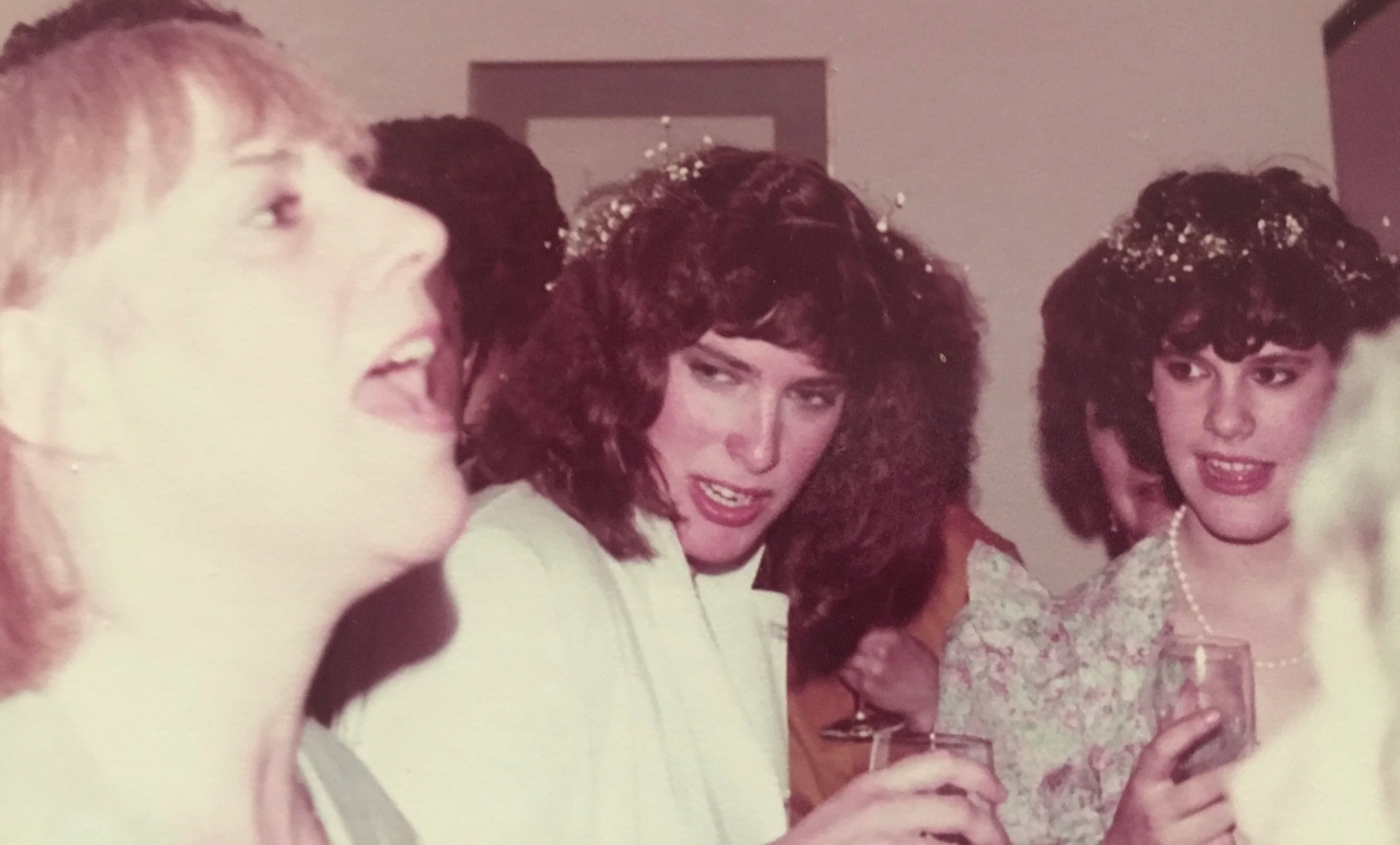
Author’s mother holding court, her daughters usual reaction.
Word Count 1335
Whenever I see someone on TV at an awards show, crying, humbled, and telling the world that as long as you have a dream and you work hard, you will succeed, my first reaction is to spit.
My mother had a dream. Which is probably why my sisters and I pretty much don’t have dreams, at least not dreams of greatness, immortality or fame. Or, if we did once, we worked hard to disabuse ourselves of the notion.
My mother wanted those things badly. I know I’ve written about her a lot. But when the failure issue came around, and I coursed over my own life, which has failures of plenty, mostly rising its inconvenient head during my own career, my thoughts kept coming back around to my mother.
Born in the East End of London, she deemed only three or four instances of her life worthy of telling. Her brother drowned on his birthday in the Thames because he was wearing new shoes that had no grip on the slippery causeway. She had to spend a night alone sleeping in the same room as her sister who had just died of leukaemia. And that very Christmas eve, her father took a small glass of port.
Her family was ordinary; too ordinary, she said, to have any more stories of note. My grandfather was a bookmaker, or, in American parlance, a bookie. My grandmother seemed to have been a homemaker who would have bouts of either alcoholism or perhaps just boredom- but who would disappear for days, leaving the kids to fend for themselves. But my mother was bright and articulate and won scholarships. I’m not sure who first said that the more words you have, the greater your thoughts are. Mother had words; they were her saving grace and her weapon.
After the war, she made her way to Canada, where she had, someone would say, a sterling career. A TV show, a newspaper column, radio spots. She was Canada‘s answer to Irma Bombeck. A little more caustic. And definitely less in love with her husband and her children.
But it was not enough. It was not close to enough.
As we grew, we became aware of her unhappiness, her chafing at the bit for something greater. By extension, she was determined that our lives would have to be glittering successes. The only problem was that she didn’t take into account who her children were, so the dreams she bestowed on us didn’t actually fit our characters.
She decided that I should be an actress. Not taking into account that I had no interest or inclination. I was sent off at the age of seventeen to HB Studios in New York. I promptly dropped out. But that’s another story. Not that she dwelled on my decisions or early failure. She was definitely not one of those mothers who lived for her kids.
A couple of years later, due to the political situation in Quebec, most of her work dried up. Toronto beckoned. They were offering her, this twice-displaced English woman, a refuge. Perhaps not her own column in The Toronto Star, but she certainly could do some stuff for them. Maybe not her own radio show beaming from CBC Toronto, but she certainly could contribute stories. In Canada, you weren’t cut loose and left to drift and die in obscurity if you already had a reasonable career.
What did she say to this lifeline? No.
Instead, she phoned me and said, "I'm moving to New York. Find us an apartment."
(Side note. A couple of years later, Ira Glass was starting a show called This American Life out of Chicago; he called Mother and asked if she would like to be part of it. She turned him down flat. "I didn't make it to New York, only to end up working for some start-up show from middle America!)
Things started well enough. She had a book contract. Soon she was making contacts in magazines and started writing pieces for GQ, Lears, Vogue, and her most successful place of employment, The Village Voice.
I marvel at that, I truly do. A fifty-two-year-old woman moving to New York, starting a new career, and getting reasonable traction.
But then she began to slip. Her ideas were too British. Her humour too caustic, and there was never a sentimental note at the end.
And again, no fault of her own, magazines started to shrivel and die. But she kept at it. I remember for years hearing about Ina Claire. Mother was obsessed, and knew if only she could get a contract, she could write a stunning novel about her or a biography. Who the hell was Ina Claire or Clare? I had to google her. Either she was a 1930’s film star who was once married to John Gilbert or was an extra on The Eastenders playing the woman who ran the flower stall in that long running British soap. Claire, the starlet, was witty and a fast talker, so that might have appealed. Clare, the extra, was on a show about my mother’s old nabe. Which was another book my mother tried to write, one about her old neighbourhood during the Blitz. But after spending most of her life trying to erase the perceived dullness of her youth, she found she couldn't reanimate it. Nothing sold. Agents fell away.
My older sister and her son moved in to help support her.
An FYI, if you have a dream of living with your parent and your kid thinking it’ll make things easier, think again.
With no money coming in except a small pension from Canada, (she had cashed in her big pension to move to New York) it was up to her children to support her. By this time, my mother was about sixty-five. She would live until ninety.
Her world got smaller and smaller and smaller till she hardly ever left her bedroom. Eventually, we moved her out to Los Angeles to be near my younger sister. And though she never stopped sending pieces out or contacting old contacts, writing proposals, believing some big break was just around the corner, if they only loved her Clare book, if they only loved her Blitz book. But nobody loved them. Nobody cared. Nobody got back to her.
When she died, I contacted the Gazette to see if they wanted to do an obit. They never got back to me.
My mother’s mental health had been deteriorating for years and cleaning out her apartment was a hazmat situation. I went in with the intention of going through her papers carefully, reading as much as I could, saving her better columns, her completed drafts of books, with the thought that I might one day get some of her stuff republished. Talk about delusional.
By the second hour, I was shovelling all her papers, her columns, and her book drafts into huge green garbage bags. By the end of the day, with my brother-in-law and sister, we hauled seventy years of writing, work, dreams, and ambitions to the dumpsters behind her building. Even her precious books- she spent years collecting expensive film and fashion books--had been so neglected they were now riddled with mites and bed bugs; whatever the hell else eats shiny bits of paper, so they too went in the hopper. She always claimed she had no time to clean; she was too busy, in much the same way, to deal with us kids. "I can’t stop, Bex."
It was all work, work, work.
After we heaved nearly twenty huge garbage bags into the dumpsters, my sister and her husband went back upstairs to start throwing out greasy old pots, pans, and dishes that were never properly scrubbed. I stood by the dumpster a moment.
My mother‘s whole life, here in a dumpster in Sherman Oaks, California.
Am I bitter? Damn straight I am.
And don’t ever tell me to follow my dreams. I might punch you in the face.
Bex lives in France with her husband and their dog. She is the author of the novels (Under Bex Brian) Promiscuous Unbound and Radius. At present, she’s working on a new novel entitled, Finnick