Hunting For Boars
Gabriella Savarese
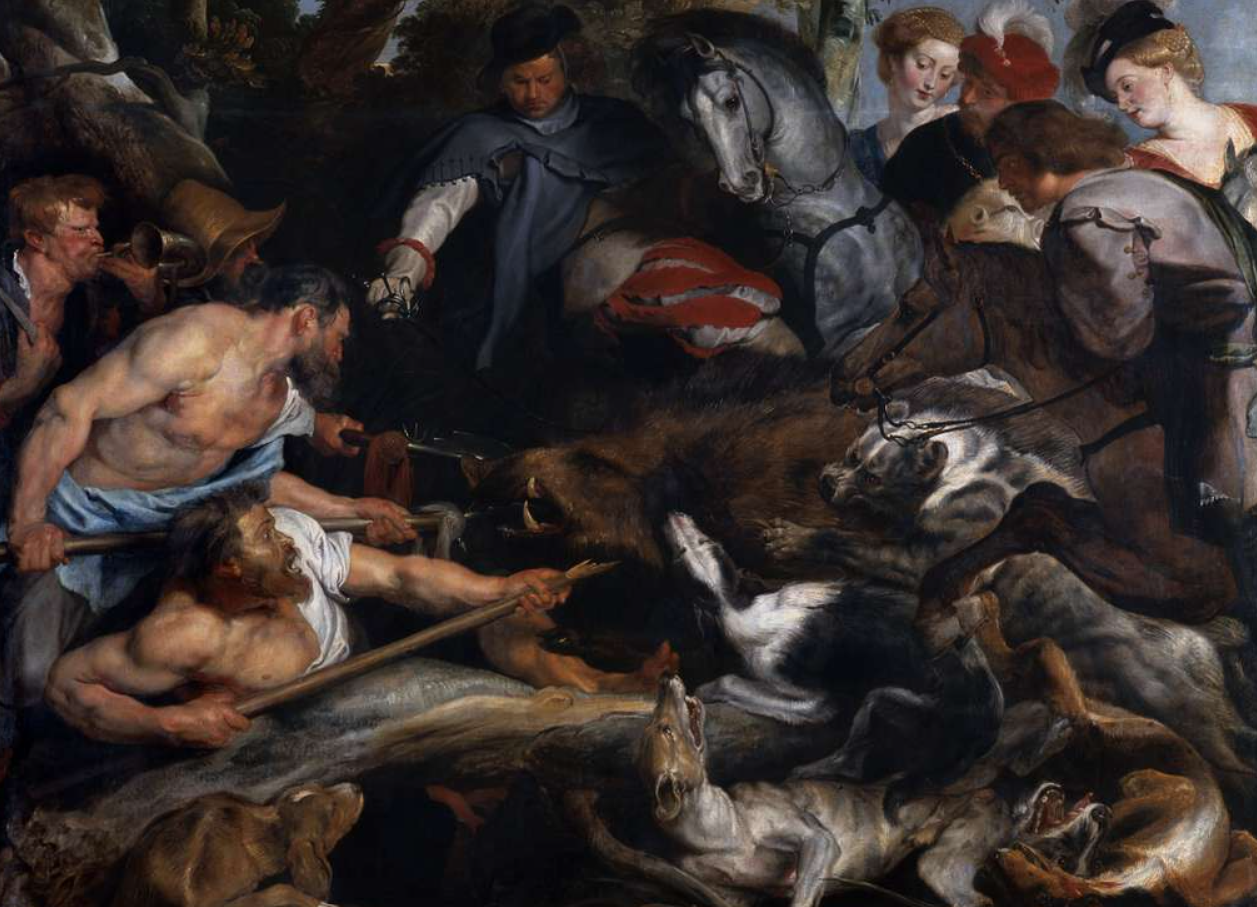
Peter Paul Rubens, The Boar Hunt, 1615
Word Count 1655
Gianni shows up at our door at a quarter past one. He’s still wearing his work clothes—a white smock over loose striped pants. Tucked under his arm is a leather bag presumably filled with the tools of the trade.
“Buongiorno,” I greet him, shaking his hand. “Thank you for making this exception.”
“Of course, of course.”
My father lives in a small town on the southern coast of Sardinia—if 4,500 souls even qualify as a town—where doctors still make house calls, where everyone knows everyone else, where barbers are your friends.
“This way.” I lead him toward the master bedroom. “He’ll be happy to see you.”
When Gianni catches sight of my father, nearly buried under the covers, he falters and a tiny gasp escapes his lips. It has been over a month since Dad has gone to his shop, as he has done every month for the last thirty years. A lot can change in a few weeks. My father certainly has.
Dad looks like a sparrow that has fallen from its nest. Scrawny, all skin and bones, disoriented. His head turns this way and that, the tendons in his neck taut like guitar strings, a bewildered look in his eyes as if he’s trying to figure out what happened and how the hell he got there.
A bolt of guilt snakes up to my throat. How could I have let it go this far? I should not have allowed him to lose so much weight. When he stopped eating solid foods, I did my best to concoct appetizing and nutritious smoothies and protein shakes. But my efforts have largely failed. Yet, I feel as though I should have done more, better. Tried harder.
To his credit, Gianni recovers almost immediately. “Oy, Ziu Antiogu, cummenti staisi? How are you?” He asks in Sardinian.
My father perks up and his gaze zeroes in on Gianni.
“What’s the matter,” Gianni continues as he steps into the room and approaches his bedside. “Getting lazy in your old age? You made me walk from my shop just to give you a shave?”
My father smiles, a toothless smile because the doctor told me to remove his dentures. To my surprise, Dad answers. “Eh, it’s because I’m sick and tired of getting these ugly haircuts,” my father responds. But his typical sarcasm is lost in the gravelly sounds that issue from his lips. He turns toward Gianni who has placed his bag on the bed. “I’ve heard there’s a pretty good barber in the town next to ours. I have a mind to go check him out.” His voice is a whisper.
“Go right ahead. Don’t complain to me though when you come out looking like a scarecrow.”
Gianni spreads a leather apron on the side of the bed, opens his bag and pulls out his tools—scissors, combs, a brush with bristles as soft as baby’s hair, a straight edge razor, shaving cream—and lines them neatly next to my father. With a mother’s tenderness, he wraps a smock around my father’s neck so that no stray hair will fall on his body making him itch later. All along my father is watching him. Carefully. Intently. With the same intensity and focus I watched my dad’s every move when he shaved in front of the bathroom mirror when I was a child, wishing I were a boy so I could shave one day, wishing I were a boy so he’d teach me what he knew.
Gianni begins with my father’s hair, or what is left of them. A scissor in his right hand, a comb in his left, he trims the loose strands which have gotten too long since Dad has been confined to his bed four weeks ago when his body failed him the day after his eighty-third birthday. All along he talks to him. He tells him about his clients. About his day. But mostly, he reminisces about the years they’ve known each other. The years he’s been his customer. The years they’ve been friends.
“Ziu Antiogu, you better get well soon.” Chop, chop, trim, trim. “I can’t come here every three weeks to give you a haircut!” Comb to the right. Pull, cut, comb. “I’m a busy man, you know! But I’m sure glad to see you again. Everyone is asking about you.”
My father opens and closes his mouth, but no sound comes out. His eyes are fixed on Gianni.
“Hey Ziu Antiogu, t’arregordasa? do you remember when…” his voice is gentle, soothing. And even though Dad does not respond, Gianni continues to tell the tale. Within minutes, he’s done with the hair. He combs it gently just the way my father has always combed it. Parted on one side.
Gianni moves to the beard.
Using a barber’s brush, he lathers my father’s cheeks with shaving cream. I can see Dad slowly relaxing under the familiar touch. The tension in the tendons of his neck slackens. He’s enjoying it and listening to Gianni’s soft soothing voice. The familiar cadence of the Sardinian dialect.
“Do you remember that time we went boar hunting, and that boar charged me, Ziu Antiogu? God that was a day to remember. You saved my life!”
My father doesn’t say anything but stares intently into Gianni’s eyes as if the words were a lifeline that keep him tethered to this world.
Leaning against the doorframe, I watch these two men, these old friends, as if watching something holy.
With one hand Gianni stretches Dad’s right cheek while the one holding the straight razor clears a straight runway from cheekbone to jaw. Move the finger, pull the skin, razor blade cuts another swath. “Do you remember how he charged me? Su santu ki da fattu, it was huge.” Lift nose, shave upper lip. The blade moves to the right, to the left, down the center.
“I froze. But you pulled your gun and BAM! You nailed him with one shot and good thing you did because there was no time for a second one.” Pull up lower lip. Blade moves up along chin. To the right, to the left, up the middle. “I bet your wife was happy seeing you come home with that big piece of boar meat.”
Left cheek. Pull it taught with one hand. Shave a clean swath down the middle with the other.
“She sure did love boar meat. God rest her soul.”
She did, and so do I. My mother cooked it perfectly with local bitter olives in a white wine sauce. After I moved to the States, Mom often froze boar meat so she could cook it for me when I came to visit. It’s been years since Dad has gone hunting, years since I’ve had a taste of Sardinian wild boar. I probably never will again.
“Could you soak this towel in warm water?” the barber asks me.
I take the towel from his hands and go to the bathroom. While I wait for the water to run hot, I listen to the monologue that is taking place next door, like a prayer.
When I hand the towel back to Gianni, he stares me straight in the eyes. My heart stops beating for a moment. And I wonder if it is reproach I read on his face. I wonder if he thinks I’m doing a terrible job caring for my dad.
When the doctors told us he was terminal, Dad refused any extraordinary measures. “I don’t want to die in a hospital,” he said. So I arranged for pain therapy, and, when it became necessary, an IV for hydration. Nothing more.
At that time, I had no idea what I was getting into.
I didn’t know that my two-week visit would be extended indefinitely, that in less than two months his body would fail him, and he’d be confined to a medical bed. That I would have to muster the gumption to wipe my own father from frequent diarrhea accidents or clean the open wound in his abdomen where the tube for the urine bag inserted. That I would have to learn how to change his clothes and sheets with him lying on the bed. That I would have to advocate for him to get better and stronger pain meds when the ones he had been prescribed were woefully inadequate. I am anything but nurse material and my only experience changing diapers was with my three children a lifetime ago. I haven’t lived in Italy in twenty-six years. I don’t know how to navigate the complex bureaucracy of nationalized healthcare. I am way in over my head. And I’m afraid it shows.
The barber wipes down my father’s face and neck with the warm towel and then pats his cheeks with aftershave. He replaces all his tools in the bag and tucks it under his arm.
“Ziu Antiogu, I’m done.”
My father startles, as if he forgot the barber was there. With each day his behavior has become more erratic partly due to the pain medications, partly due to the toxins that are accumulating in his body as his organs begin to shut down. He looks up at Gianni with the eyes of a child, trusting and vulnerable.
Gianni visibly swallows as he cups my father’s hand with both of his. “I will see you in a few weeks,” he says. But as he says goodbye I know he knows there won’t be another time. Gianni holds my father’s hands in his for a few minutes. I hold the tears back as I watch these two friends say goodbye.
“How much do I owe you?” I ask when he steps out of the master bedroom.
“It’s no charge.”
“Are you sure? That’s very kind. Grazie.”
“Dovere, dovere.” Before he steps out into the street Gianni turns toward me and holds my hands in his. “Brava,” he says and walks out into the hot August sun.
Gabriella is a writer of memoir, personal essays, and fiction. Her essays, based on her recently completed memoir, Necklaces in the Eucalyptus Tree, have been published in Ars Medica and Memoir Land, while another won the Southwest Writers Contest. Gabriella grew up in Sardinia, Italy, and moved to the United States in her early twenties. She currently lives in Albuquerque, New Mexico, where, during her spare time, you’ll find her remodeling an old farmhouse that will soon be home to a couple of rescue dogs and a flock of chickens. To learn more about Gabriella and her work you can reach her at www.gabriellauthor.com