A Dog’s Life
Sallie Reynolds
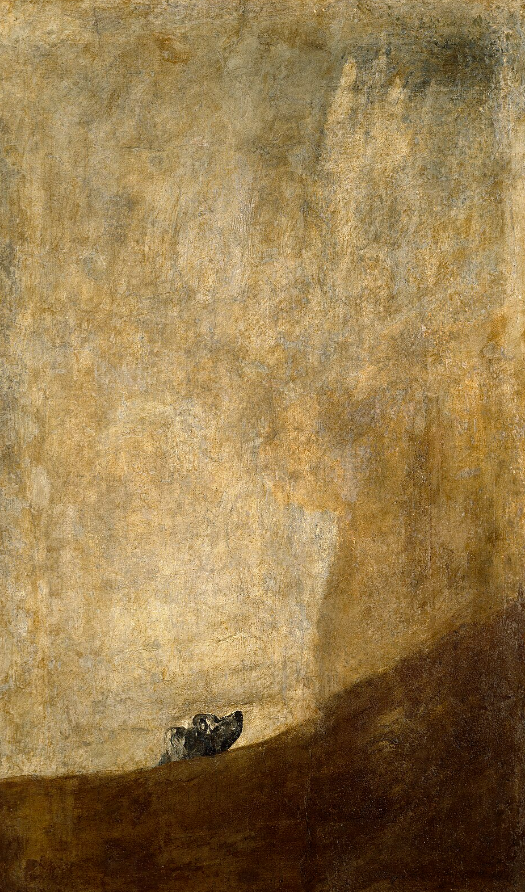
Francisco Goya, 1820
Word Count 1540
For his 25th birthday, I gave my husband a dog.
A puppy to ease his depression, get him talking again, hugging, playing with the baby.
He’d say, I like a sleeping baby! Our little Kevin, not yet two, was a sturdy, sweet child, but he didn’t sleep all that much, and he was noisy. Sometimes I felt George wished Kevin and I would disappear.
Our last year at the university had been a horror. Convinced he wasn’t going to pass orals, George stayed up night after night at his desk. He stopped talking. He poured over his piles of papers and note cards, and when the baby cried, he’d yell, Can’t you make that kid shut up? A little later, he’d get up, touch Kevin’s wispy blond hair, so like his own. Sorry sorry sorry.
On his birthday, we’d just moved to a small college town in Iowa, where George had gotten his first teaching job. All his new colleagues had dogs, and on weekends they went hunting. Sometimes they’d invite George. He began to talk about his father’s hunting dog, Bingo. He loved Bingo – loved the way his ears smelled.
When his father died, his mother gave Bingo away. Dogs, she said, were dirty. She told George his father got bone cancer in his right hip, where George, age 5, hit him with a baseball. She didn’t say George caused the cancer, but he was a child, that’s what he heard. He told me he’d killed his father and abandoned his father’s dog.
I said, You know that can’t be true! But I thought of his mother – every inch of her so concentrated on control. In all his baby pictures, George was costumed and posed – little sailor suit, little baseball uniform, logo and cap, little suit with miniature tie. You could just hear her saying: Now smile! I looked at that solemn little face, cowlick all plastered down, and said, Didn’t you ever just go out in dungarees and play in the dirt?
The birthday puppy was supposed to loosen us all up, help us make a normal, happy life.
The puppy was part retriever, black and wiggly, chewing everything. George named him Stump. They took to one another immediately. After George’s classes, they had training sessions in the park. Take Kevin too, I’d say, he’ll be fine in his stroller. But no, the baby would interrupt their routine. George and Stump were in sync, complete with a sort of eye-code. In two weeks, he was house-broken.
Every night, I was allowed to take the puppy for his final walk while George graded papers and Kevin was asleep. At the park – feeling a little guilty – I’d unclip the leash, whisper Go be a dog! And off he’d go, tail whirling – never far, always coming when I called. The park he explored was nothing like the one I knew. He went over every inch with his nose, studying the Doggie Most-Wanted List.
One evening, I climbed to the top of the sliding-board and scooted down. I hadn’t done that since I was about ten. It was a nice long slide, whoopee bump in the middle. A two-second flight for the heart.
At the bottom, I heard a noise and looked up. There under the playground light was Stump, inching up the ladder, step by step. It was really high for a dog! But before I could get to him, he squatted and shot down, ears flying up as he hit the whoopee bump. He sailed off the end and landed on his feet.
Good boy!
He ran right back and did it again.
From that moment, we couldn’t pass the park that Stump didn’t go for his two slides. He became famous in town. People had never heard of a dog that went down a slide. The butcher would say, “That pup still think he’s a kid?”
We started walking together, the four of us, every few days, and Stump would whine until George let him go. He’d crawl up the ladder – a vision I still can’t get out of my head. Then whizz down, ears straight out. When he’d had his two goes, I’d slide down with the baby, Kevin and I shrieking with excitement, Stump yapping and dancing below.
In November that year, we planned a family weekend for my 23rd birthday. George rented a cottage in the woods from his hunting buddies, and a couple of afternoons before we were to stay there, he went to clean it, get it baby-proofed. He took Stump. That night, he was happier than I’d ever seen him. Stump, he said, loved the woods, chased chipmunks, barked at ravens.
The cottage had a fireplace, and the next day George went back to split some wood.
He returned white and shaking.
And where was Stump?
Stump had eaten rat poison and died in George’s arms.
George wasn’t crying, but I couldn’t stop. We have to go and bury him, I said.
No! George said. He’s my responsibility.
He took a shovel. I gave him a handful of Stump’s treats and a little stuffed toy, which he thrust into a pocket. When he came back, I didn’t dare say a thing. He didn’t mention Stump at all.
Three weeks later, another Saturday morning – my actual birthday – I asked George to go to the butcher for some steaks, we’d have a nice dinner.
An hour went by. Two hours. Then more hours, until my skin was crawling. The butcher said George had not been in. I asked a neighbor to keep Kevin, and one of George’s fellow-profs, Steve, drove me out to the cabin.
Why here? Steve asked, what would George be doing here?
I couldn’t say it. Before we left, I’d looked in George’s office, at the gun rack where he kept a deer rifle and a shotgun. The rifle was gone.
At the path leading up to the cabin, there was our car, driver’s door wide open, seat flung forward the way you do if you’re in a rush to get something out of the back. Half way up the hill, near a little bridge, George lay face up, one arm flung out.
Steve yelled, Wait! Don’t go.
But I went.
The water in the little creek was frozen.
George’s watch was ticking. Seconds moving smoothly, on and on.
His hands were white as paper. His wedding ring stood out like a scar.
I couldn’t look at his face. Or his head. He was lying, gun beside him, on a fresh mound of earth.
Stump.
On the way back to town, my body convulsed. I ran into the woods, spewing. Steve had to stop for me again at a farmhouse. When we got to the apartment, I wrapped my arms around Kevin – his little body damp and warm. I felt his heart beating. In my mind, I saw Stump flying down the slide. Those together, were alive in my head.
It’s now more than 50 years, and I’ve never until this minute been able to write the words: my husband killed himself on the grave of the dog I gave him. I’ve told the facts of George’s death, a little string of events. But never the story of Stump. It arcs across George’s life from 5 to 25: a boy-man, terrified of the beautiful burden of living things. Even himself.
Kevin remembered more than you’d believe for someone not even two. Some years later, he said: My father loved the dog more than he loved me.
By then, he and I had learned ways to tell each other the hard things. So I could say, No, he loved you. He just couldn’t bear the responsibility of another life. Not the dog’s. Or yours. Or mine. I gave Kevin two pictures of his baby-self and his father, looking at each other.
Dogs are pure feeling. For George, for Kevin – for Stump – I should never have brought a dog into our life.
Nothing of George is left on that path in the woods. Blood soaks into the earth and is devoured by a million-million microscopic creatures.
But Stump is still there. Sometimes in my dreams, he’s bones. Sometimes just a little dog twitching in his sleep.
People say, That’s the saddest story! And then I know I’ve told it wrong. It’s not sad. It’s an ordinary devastation. Some of us freeze. Some of us live on in ways that beggar the imagination.
Let me say it again: My husband killed himself on the grave of the dog I gave him.
The absurdity – the farce – tears me to pieces. And puts me together again. Stump is the tire that goes flat while you’re following the ambulance. Your hysterical moment at a funeral. The instant the door locks behind you, and you know you’re trapped outside, alone.
But you live through it.
I said to a friend, How can I write this? When I talk about George, I feel as if I’m repeating something I’ve memorized. When I talk about Stump, I can’t keep my voice from breaking.
Write it, she said. Just let go.
So I wrote – and they slipped past my guard, the boy and the dog. Alive. Leaping.
And then they were gone.
Sallie is a near-nonagenarian who lives in a cabin in the Sierra foothills. She is a former editor, teacher, and falconer. Her recent essays and articles have appeared in Dorothy Parker's Ashes, How I Learned, Manifestation, and Oldster.