Burning Down the House
Danielle Truscott
Word Count 1317
All escapes lead back to fire. I glance at the open book of matches. Will Mum and Dad's violent night fights combust into a day fight?
While Mum was asleep, I went downstairs to the spare room we call the "extra" room, where Dad has been sleeping, to ask him for French toast. It's Saturday, and I wanted something special, a break from the constant bickering, and the news that Dad would be moving out.
It's 1975. I'm 10.
Dad, in his usual weekend-morning cut-off khakis and white t-shirt, came up, groggy, smelling fusty from cigarettes and the general storage whiff of the extra room. He took out bread, whisked a bowl of milk and egg. It felt almost normal in the kitchen.
Now Mum appears as if summoned by unknown forces. She lights a cigarette, inhales sharply.
I'll see to this, James, she says, laying the burning cigarette in the ashtray on the kitchen counter.
She's wearing her quilted pink robe. Her voice is a desert.
You can go back downstairs, James.
I recall a long-ago morning when Mum's old terrycloth bathrobe caught fire while she was cooking. A line of flame zipped chest-ward from her waist, and Dad, 6'2" and athletic, grabbed the kitchen mat and flew toward her to put it out. Although I know he'd do the same now, it doesn't feel like it.
The golden-brown slices of French toast sizzle in the pan, and the melting butter gives off sweetness and warmth.
I'm making breakfast for my daughters, Jeanette, okay? It's fine.
But it's not fine. Mum moves toward Dad, grabs the pan, and yanks it off the burner. I run over and try to turn the flame off, but turn it up instead.
All is chaos. Mum burns her hand on the frying pan and drops it on the floor, the French toast skidding across the linoleum. Everyone's screaming as we fan acrid smoke. I'm bawling; Adrienne, my younger sister, too.
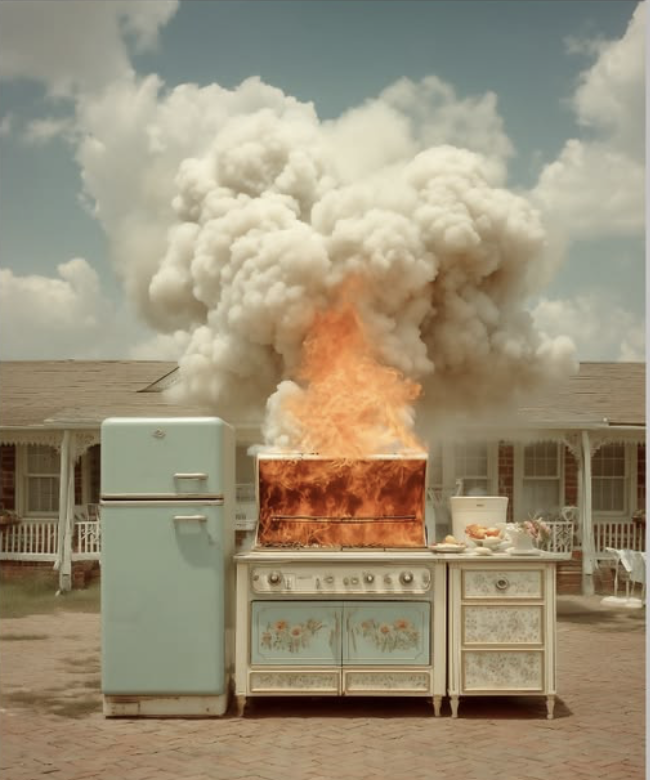
Our new life began a little over a year ago when our split-level ranch on a quiet rural road in Connecticut went up in flames while Adrienne and I were at school and Dad and Mum were at work. We never knew exactly what caused the fire, whether faulty wiring or one of Mum's lit cigarettes left smoldering beside the couch where she likes to sit and read Agatha Christies.
After the fire, we lived in an apartment on the campus of Wesleyan University, where Dad, a Dante scholar, was a professor of Romance Languages, and Mum worked in administration. It was a cramped space, and often at night I would hear Mum and Dad arguing. It was usually about the fire.
Dad: Jesus, Jeanette, you never liked the fucking house to begin with…
Mum: You bloody bastard. If you're suggesting for one second…if you weren't so cheap about spending money for proper things—proper cars, proper electricians—we wouldn't be in this bloody mess.
The new house took a year to build. Celery-green wall-to-wall carpeting covers the living room and hallway floors. New couches—one tweedy to match the carpet, and one larger, beige velvet—face each other across a coffee table, made of a granite slab and wood frame that Dad let me help him build. Ferns hang in macrame holders, and above the stereo system, sparkling glass shelves show off books, albums, and Mum's collections of seashells from vacations in glass bowls. It feels like home.
But not for long.
Soon enough, Adrienne and I find ourselves perched on that same beige velvet couch. Across, on the tweedy green loveseat, our parents sit with an entire person's amount of space between them. MumandDad, a unit taken for granted, now abruptly wrenched in two separate items. Mum. And. Dad.
It's The Talk.
Mum's breathtakingly blue eyes are bloodshot behind her glasses. The skin around her eyes beige and crinkled, like torn bits of paper bag—her voice sad and jumpy. Dad's words pared and deliberate, heart-throbbingly grave. His one visible foot, not under the table, crouches like a jungle cat as he drums it on the carpet in its big tan Wallaby shoe.
They smoke even more than usual—Mum lights up one Benson and Hedges before the other one's out, still only half ash, alive in the ashtray. They tip ash, say things. Separating. Not necessarily permanent. Change. Doesn't change our love for you. Within ten minutes, disequilibrium forms a pattern.
Dad leaves after the talk, but as promised, returns very soon—the next day, in fact. I heave with solace when I note that the duffel bag he took returns with him. He takes it downstairs, though—rather than to his and Mum's room.
This separation scares me. It's Dad who looks up, grinning, when I visit him in his study and read poems from his books. It's Dad who encourages me with my poems; who I fish with; who teaches me how to pound a nail in with a hammer to make my bookshelves; who teaches me how to pitch a curveball; to throw a punch. And this room he's in is not a proper guest room—just a single bed, no side table or lamp or pictures on the wall, a bare bulb overhead. We call it the "extra" room: a storage room more than anything: boxes piled up with precious photos and other family things that were smoke-damaged in the fire, things we'd keep in a garage or shed if we had one—Dad's toolbox, a couple of propped rakes and brooms in one corner. It alarms me to look in there, but I glimpse through the open door when I go to see him in his study that there are some books, a half-empty glass of water, an ashtray and cigarettes on a box pulled up next to the bed. As weird as our days are, I am just glad Dad is still in the house.
On the day of the fire, the school's scratchy loudspeaker calls Adrienne and me down to the office. Mum waits in her turtleneck sweater, plaid skirt, and knee-high navy suede boots. When we get to the house, I see Dad standing on planks that form a makeshift walkway out to the place where our house used to be. Firemen in bulky canvas turnout gear move around the smoky ruins. One directs a hose on a hotspot. Another stands beside him, writing in a notebook. I step cautiously on the planks toward Dad. Below, I can just make out through the ruins charred bits of wrecked things.
No farther, Dad commands.
But I've already stopped. Between Dad and a suited fireman, I see something I can't take my eyes off. It looks like a bashed-up head of one of the villainous, robotic Daleks from Dr. Who, or a giant, melted astronaut helmet. I realize it's our TV, tilted and poised as if about to plunge into the chasm below. All is a messy, scorched facsimile of what it was. Furniture, photos, books, toys, art we made at school, clothes, our dining room curtains with jousting knights on them, the mustard-yellow telephone with its curly cord on the kitchen wall.
Our new, rebuilt house has the same mustard-yellow telephone with a knotted-up cord, just like the old days. But Dad's in the hall with a duffel bag, half-unzipped, and I note his favorite, bulky hardback edition of Inferno on top of his clothes and other belongings. He hugs us and says he'll be back soon. My face feels fireball-candy red-hot, and feverish with tears scrambling to come, and I feel as though I can't breathe, as if my lungs are packed with something hard, like the logs Dad and I would split for the fireplace when our family used to play cards or Tiddlywinks in front of the fire on a winter's night.
Somehow, I know that he and the bag are not coming home.
Danielle just finished a fast-paced, high-concept twisted psychological thriller set in her ancestral village on England’s atmospheric southeastern Cornish coast. Currently, she works as a freelance writer, ghostwriter of rock-and-roll and other memoirs, and fiction editor. She served on the board of the PEN American Center from 2010 to 2016, helping to rewrite its mission statement and by-laws, heading the committee for Authors’ Evenings, and working with the PEN Prison Writing and Freedom to Write programs. In 2018/19, she co-founded, curated, and contributed most of the books for a library in the bilingual, progressive Antigua International School in Antigua, Guatemala. In earlier years, her flash fiction and poems were published in the Asheville Poetry Review, Oyster Boy Review, and other journals, and a review of her work in Small Press Review noted that “as to her poetic voice, what Sylvia Plath did for German, Danielle Truscott does with the Celtic tongue.” Danielle worked as a staff reporter for various independent weekly newspapers, contributing news articles and arts reviews to the Fund for Investigative Reporting and The Village Voice. After living in New York City for twenty-something years, she now lives in Connecticut.