Cooking With Fire
Bex O’Brian
Word Count 667
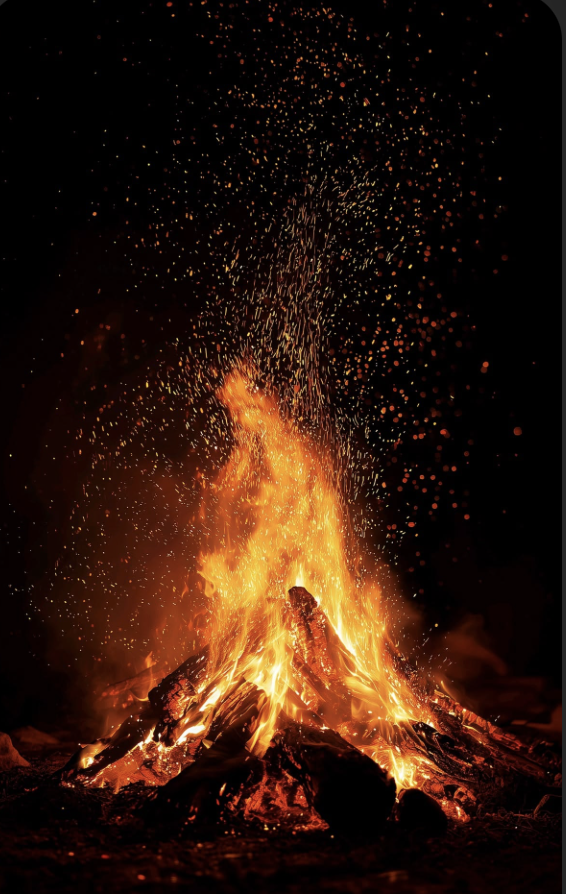
My family and I all stood around the campfire set off in a field as the night's chill pressed in. Off in the distance, we could see the lights of the nearest small town and an amazing splash of stars. On the grill was the rabbit my father had shot and killed that morning. Every once in a while there would be a small flare-up when a buckshot pellet released from the ever-shrinking creature fell into the fire. There were only two choices, face the fire and its intense heat while your back froze or vice versa.
As my father set out to kill the rabbit that morning, I felt inordinately proud. This was survival at its most elemental. Growing up in Canada — albeit downtown Montreal — I had a proper English father who, whenever we went to our cabin in the Quebec woods, chose to behave like a new-world Denys Finch-Hatton — sundowners and proper dress in the evening, but survival skills pressed on his four daughters come daylight.
When my father deemed the rabbit done, we were handed a charred minuscule piece which, judging by the discreet spitting going on, was more buckshot than actual meat; even so, we all pretended to be grateful to sup that night on the bounty of my father's efforts. Thank god for marshmallows, the bribe that got us to eat the poor rabbit in the first place.
Years later, I would think of that night when I was beside yet another campfire, this time in Kenya, near Lake Turkana. I was working on an ethnographic film about the Turkana tribe. Most of the filming had been pretty benign as we followed the nomadic tribe around which, to my disappointment, did not wander hither and yon on a whim but rather followed strict routes. But this Nilotic tribe, apparently, had some media savvy. When a camel turned up lame, they wanted us to film how they would have killed it in the good old days before guns. Sacrificing such a valuable animal was only done to ward off starvation during times of extreme drought and was treated with due reverence. One problem with this plan: the younger members of the tribe had long forgotten how to wield a spear with any of the strength and grace needed to dispatch the camel without causing suffering. Most of the spears pinged off its flank. A few made contact but nothing close to a kill. Finally, an elder could take it no longer and put the camel out of its misery with a bullet to the head. The kill may have been bad, but the camel did not die in vain. As special guests, we were presented with a rib, which our hosts told us, was the prime cut. That night we built an extra-large fire. The heat was intense, not helped by the night temperatures hovering around 31 degrees. As the only woman on the crew, I was tasked with roasting the rib. If a human can feel like a cartoon character, then Fred Flintstone had nothing on me, as I grappled with the three-foot rib. The fat repeatedly sent out missiles, and I still bear the scars on my chest — not to mention my hands — from trying to turn the damn thing in hopes of roasting it evenly. When I sank my teeth into the gamey, greasy flesh, the tribe all nodded with approval. I don't know if they kept the rib for a bone broth. I hope so, for the visual alone.
Somewhat surprisingly, I love to cook meat on a wood fire. Every time I gather kindling and begin to build my pyramid to ignite a fire that will eventually crackle down into a bed of glowing embers, I feel stirrings right down to my DNA. Here I am, I think, part of a legacy of the survival of the fittest and I can take the heat.
Bex lives in France with her husband and their dog. She is the author of the novels (under Bex Brian) Promiscuous Unbound (Grove Atlantic) and Radius (Spuyten Duyvil). At present, she’s working on a new novel entitled, Finnick.