The Piano Man
Suzanne Orrell
Word Count 2021
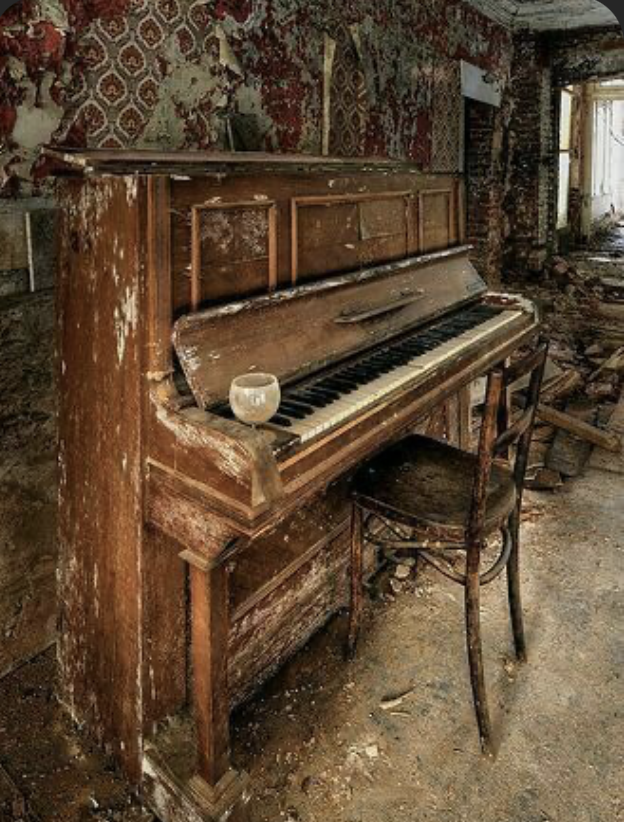
I pulled back the blue plastic tarp, lifted the keyboard cover. My hands, with their squared off fingernails and trimmed cuticles, easily found middle C. Two octaves of the C major scale pierced the afternoon heat in the workshop barn at my in-laws' house. The piano sounded decent enough considering it had sat, ignored for five years. There were no windows or skylights. No plumbing. No cooling. No heating.
I was about to move to Vienna to re-join my husband after a lengthy separation. Before moving overseas, I asked my son if he wanted the piano. Like me, he started taking piano lessons in first grade. He knew this was the piano my father learned to play as a boy. But shipping it to him in Las Vegas would cost more than the piano was worth.
My next plan was to donate the piano to a church or civic group. I thought the piano might be played by small hands––maybe with bitten fingernails like mine when I started. Or maybe it would find its way to a retirement community where senior citizens with age-spotted hands could play music long remembered. I thought making the donation would be a cinch. Who would turn down a free piano?
Turns out, everyone.
*
My father, an oral maxillofacial surgeon, was obsessed with his hands. They were the tools of his highly specialized trade. My father's hands looked like they held knowledge. Not overly big, his metacarpal bones were pronounced, lending heft. His nails, always trimmed short, never sported hangnails, ragged cuticles, blisters, burns, or scars. He never helped with dishes, rarely did household projects. There was a small workshop room in the basement where he kept a toolbox. The toolbox held a hammer, screwdrivers, and adjustable wrenches. The basics. He hated to hammer in case he accidentally whacked himself. "I can't operate with a swollen index finger or thumb," he'd say. "If I can't operate, where will the money come from, how will the bills get paid?" Always worried about money, he rode his high-spirited American Saddlebred every weekend, while my mother asked his permission to buy a winter coat.
In childhood, whenever I came down with a cold or sore throat, my father examined me, gently placing his hands on my neck to feel for swollen glands. Next, he reached into the box of wooden tongue depressors kept in the hall linen closet. I could tell by the way he maneuvered it along the inside of my cheeks that he was an expert, an accomplished doctor, that I was in good hands. But when I wasn't sick, he was different. Unpredictable. I never knew what to expect from him.
My parents separated in 1974. The divorce was finalized in 1975 when I was 15. Before I graduated high school, my mother told me: "If I could have figured out a way to stay married to your father I would have. But I hated living with the bad version of him and got tired of waiting for the good version to show up."
During my entire adulthood, my father visited me three times. I visited him and my stepmother every summer after my son was born in 1989. I visited him before leaving for Vienna to reunite with my husband because I knew it might be the last time I'd see him alive. By then, he was suffering the late stages of emphysema, tethered to an oxygen tank.
When I arrived for that visit, my father was uncharacteristically sweet and attentive. I wanted to believe his behavior meant he'd truly miss me. But his sweetness was actually my clue that trouble was lurking.
As we sat at the kitchen table, our coffee cups in hand, my father said, "I need to talk to you about something. It's not easy for me to ask this, but I'm asking anyway." He choked up, tears wetting his cheeks, his oxygen tank hissing in the background. Immediately, beads of anxious sweat prickled the length of my spine. I thought I was prepared for the worst, but nothing prepared me for what he said next.
"I've spoken with an investor," my father continued, "and I've been told I don't have enough money to leave for my wife. She won't be able to afford to stay in this house, and she doesn't want to move. All I'm asking, just this once, is for you to give us $4,000 a month until I die. Maybe another six months or so after I die. I don't want you to think I've been irresponsible with money, and I'm so ashamed to ask, but you're my only hope." He looked wild, his eyes and face reddened from crying. His hands, once so capable, now bony and gnarled, gripped the coffee cup, like he was holding on for dear life. He looked at me, expecting an immediate answer.
I sat stunned. Silent. Fuming. The clear plastic tubing connecting the oxygen tank to my father coiled around the perimeter of the kitchen and adjoining sitting room. How dare he ask this of me? I was kicking myself. Why had I even bothered visiting him? He probably wouldn't have asked had I just called one last time before I left. I remembered all the times I'd wished for a father who put my needs first instead of only thinking of himself. And the timing. Now that my husband and I were back together, my financial situation was more stable. My father knew it. Finally, I said the only thing I could, which was that I needed to talk to my husband before giving him a definitive answer. "And Dad, be prepared. We're going to need full disclosure about your financial situation so we can make our decision," I said.
"Oh sure, sure. Of course. Whatever you need. You're my girl. I'm not hiding anything. I swear. You believe me, right? I wouldn't lie about something this serious. You have a big decision to make. You're good people. You'll do the right thing. But I need an answer soon. The sooner the better."
*
I didn't say anything about my father's request until I was over the worst of my jet lag after arriving in Vienna. When I did, my husband was also speechless. We spent the next week discussing the financial information we needed from my father to even remotely consider his request. And we were going to decide in our own good time, without consideration of my father's "the sooner the better" request.
I wrote email after email to my father asking for bank statements, mortgage papers, retirement account information, stock holdings, the value of both cars, and other assets.
My sixth attempt was met with a rude, "Why do you need to know all these things?"
With that, our decision was made.
I emailed my father to say that we couldn't help him since he hadn't provided the information we'd asked for. He replied saying I was selfish. If I was truly concerned about him, I would simply help him without question because, "That's what families do."
I read and re-read that email, trying to make sense of it. Finally, my husband said,"Stop torturing yourself.” He was right, as he usually was about these kinds of broken things. I exhaled deeply as I hit the delete key.
That email was the last communication I had with my father. Less than a year later, on March 10, 2019, he died.
*
When I knew we'd be moving back to Albuquerque, I started imagining setting the piano ablaze. I imagined it repeatedly. My pulse quickened picturing the heat shimmer as I watched fingers of smoke twist skyward. I imagined the pile of char, the ash at my feet cooling into remains.
I asked my husband if he thought burning the piano was something I could do with his help. "Sure, we could do that," he said. "We'd have to move the piano out of the barn, clear the weeds before dousing it with gasoline and lighting it on fire."
"Right. And we'd have to do it in the morning when the winds are usually calmer," I said.
That summer, Albuquerque's temperatures hovered at 98 degrees with 15% humidity. Afternoon winds of 30 miles per hour blew for days. New Mexico was officially experiencing moderate to severe drought conditions. The land was parched, thirsting for relief.
I realized burning the piano was way too risky. I would have to content myself with my mind's eye image of the gasoline-soaked piano, the whoosh of the wooden match, the moment of ignition before becoming engulfed in flames.
If I couldn't destroy the piano with fire, I'd settle for another form of disappearing the piano. Luckily, the barn held implements of destruction in multiples.
The best way to disappear the piano, I decided, was to disassemble it, then haul the pieces to the city dump in the back of the pickup truck. To execute this plan, I gathered my tools: several different sized screwdrivers, a hammer, a mallet, a crowbar, wire cutters, and a small axe. My husband wheeled over a 40-gallon trash container. "Here you go, sweetheart," he said. "Have at it! You've wanted to do this for a long time."
It was one hundred degrees in the barn, making the piano disassembly even harder. I had hoped to keep the keyboard intact so my husband could turn it into a modern-day player piano, but I couldn't remove it in one piece. The piano was proving to be a true beast.
I was hot, tired, and disappointed I couldn't set it on fire. The pile of debris had outgrown the 40-gallon trash can. I wondered if the pieces would even fit into the back of the pickup. Once I got the front panels off, I couldn't make any more progress with the hand tools I'd selected. "Power tools," I told my husband. "That's what we need."
"It's about time," he said.
I started with a Sawzall reciprocating saw but within ten minutes had to swap in a new blade. I was sweating so much that sawdust stuck to my arms like a sawdust sweater. My husband took a turn with the Sawzall. Finally, we were able to get to the strings. I had an array of wire cutters to choose from. Now I was the surgeon. I'd imagined this part would be easy, that the strings would just ping apart as I cut them from their hammers. But I was wrong. I didn't have enough strength to sever even the thinnest strings in the treble register. We scratched our heads, wiped our brows, and decided to put another new blade into the Sawzall.
The Sawzall cut the strings with ease, making them spring to life like a dancing cobra. We danced, too, trying to stay out of their way as the strings whipped through the air, threatening to slash our exposed arms.
Several hours later, the piano destruction was complete. Loading splintered wood, severed piano strings, and the yellowed keyboard into the back of the pickup took all of fifteen minutes. So did the trip to the dump. We showed our ID at the entry gate, paid the $5.25 fee, and headed toward the unloading area. We backed into our spot, the concrete trough below us. Other people were emptying their pickups, but I was pretty sure I was the only person discarding a dissected piano.
I knew the keyboard was the first piece I wanted to release. It took both of us to lift it out of the truck. We each held an end, counted to three, then swung it over the yellow steel pipe barrier into the collection trough below. We timed our throw so I could hear the wham-bam of the keyboard just before the shoveler truck swept it away, the frayed keys splintering as they hit the concrete. One piece at a time, I chucked the piano away. The strings, too unruly to pitch in one fell swoop, were tossed by the armload until there was nothing left of the piano.
Suzanne is a former chef and caterer turned writer. Her work has appeared in Hippocampus and The Manifest Station. She lives in Albuquerque where she writes But First Breakfast, a Substack newsletter in which she explores life through her favorite meal of the day.