The Jew Who Loves Christmas
Nancy J. Brandwein
Word Count 1333
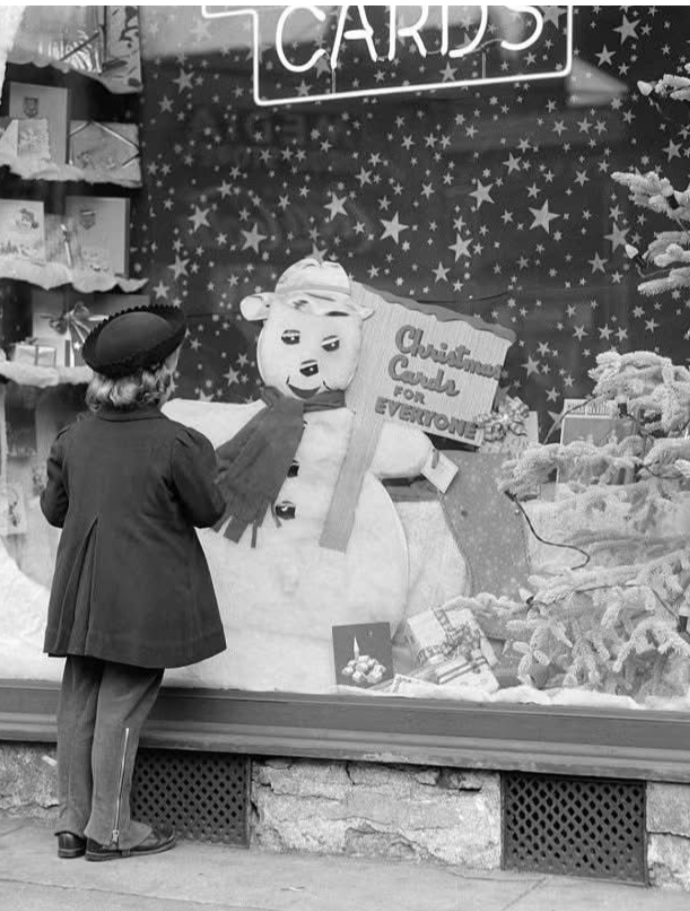
It happens every year. Sometime in the feverish runup to Christmas, when I find myself on the floor amid rolls of cheap drugstore wrapping paper, gifts strewn at my knees, I feel a profound sense of misalignment. I’m an actress who has suddenly forgotten all her lines or worse, found herself in the wrong play. It is 1967. I am a nine-year-old standing in the dark hallway of our house, looking out the window at the brightly lit houses throwing colored shadows on snowdrifts.
One of two Jewish families in our Virginia subdivision, we were chosen each year to judge the annual Christmas tree light competition. Jolly in our wood paneled station wagon, my parents drove my sister, brother and I slowly around each cul-de-sac. I favored the most garish displays—the Whitmoyer house on which every eave and window was outlined in blinking lights. I also loved the otherworldly blue and green bulbs flickering in the Stefanson’s pine grove. My Brooklyn-born mother, in thrall to the WASP code of the neighborhood ladies, preferred the understated “Colonial” look, one lone electric candle in each window, perhaps in a nest of holly bows. As Christmas day approached, I roved in a pack of girls from house to house singing the carols I had learned in school. “Ooooh Star of wonder, star of light!” I sang as lustily as the girls who went to church and knew the significance of the “holy infant, so tender and mild.” Yet, when our shrill soprano voices trembled and hushed in “Silent Night,” I felt chills up my spine and a fuzzy impression of God in the night sky.
While the neighbors were attending midnight masses, or entertaining housefuls of friends and distant cousins, our family watched 1940s Christmases play out on the TV in “It’s a Wonderful Life,” and “Miracle on Thirty Fourth Street.” When George Bailey reads the inscription from Clarence Oddbody, Angel Second Class, “No man is a failure who has friends,” the words could comfort or taunt me, depending on my shifting place in the classroom and neighborhood. This was the year I used my artistic talent to earn a seat next to Kimberly Benton at the lunch table—handing over drawings of fashion girls on cardboard inserts from my father's shirts. This was the year I was cast as an asteroid in the class play, Mrs. Meyer’s enactment of the solar system. Kimberly Benton was the sun in yellow tights and taffeta, and the first rung of the planets were her minions. Along with Nadine Lybarger, a plump girl newly arrived from Nebraska, I spun around the stage in my pink tutu, endlessly circling the rest of the girls. This was the year Mrs. Meyers wrote “Stopping by Woods on a Snowy Evening” on the blackboard in the neat cursive of the third-grade teacher, and my feeling of kinship with the poet on his little horse in the dark woods was immediate and visceral.
“The only other sound’s the sweep
Of easy wind and downy flake”
It was always snowing in my childhood winters, and in the amorphous time between Christmas and New Years my ears were cocked for the sound of sleds scraping past our house up the Pascoe’s hill behind us. If, peeking through Venetian blind slats, I saw the primary colors of parkas and boots flash through the snow, I suited up and ran down the ragged path to Lake Barcroft, hoping Linda Mead, the ringleader of our crowd, would be there on the ice ruling over a game of Crack the Whip. Holding mittened hands, we skated in a line and gathered speed until the line broke and skaters on the whip’s tip were flung out over to the lake’s edge: bumpy and mottled green with sticks poking out and sometimes the eerie image of a fish. More often during the Christmas holiday, I was alone on the frozen green expanse. I’d skate down the lake’s length, my chest warmed by the hope of finding a friend. Then on the lonely skate back I’d see the little bonfire where we skaters warmed our hands and feet. There would be my friends with strangers, the visiting cousins, ready to go out on the ice as I took numb feet out of stiff skates. I’d walk up the road to my house, skates bumping against my back and enter through the basement inhaling the familiar scent of roasting meat, wood smoke, cigarettes. My father, mother and older sister Carol would be watching old movies in the family room. I’d sit with my back to the fire, while my sister leaned against my mother’s legs, rubbing them with Jergen’s cream as my mother massaged her neck. My father chain-smoked and cracked walnuts. I was always moving between the two worlds of our self-contained family and my ragged pack of friends, and they exerted the stronger pull, even though I often found myself on the outer edge, like the last person flung out over the green ice.
Shy and overweight, Carol clung close to home and was my bulwark against fickle friends. We exchanged secret hand signals and scurried up to our shared room and the fantasies we spun with our dolls. There we took all we had learned from the movies and school to create an unabashed celebration of Christmas in our sleek Swedish dollhouse. We took pinecones from the yard outside, dotted them with Elmer’s glue and shook vials of glitter them. Carol expertly cut our parents’ matchboxes into tiny squares we wrapped with shiny red and green origami papers. The moment we positioned our dollhouse family around their own pinecone tree, nestled in a bounty of gifts, was deeply satisfying.
Against Christmas, how could Hanukkah hold sway in my heart? A holiday that jumped around the calendar, it seemed always on the verge of being forgotten by my parents. We had all the right props—the brass menorah and the cheap colorful candles that burnt down to stumps within minutes, small rubbery dreidels, net packets of Hanukkah gelt. Yet no one had breathed any animating life into them. We received one or two presents each, sensible items like a book or a sweater, not the extravaganza I saw under the Mead’s tree in the Christmas aftermath—the creepy crawler kits, the easy bake oven parts or paint by number horses. Looking back, I am struck by how isolated we were from our neighbors, and from our extended family in New York City with whom our parents had fraught relationships. We were not part of the community at the synagogue we attended sporadically, nor did we have Jewish family friends. By the time I left for college, my parents dispensed with Hanukkah altogether, which they had always called “a children’s holiday.”
It is no small miracle now to have a home festooned with pine garlands today and a fat fragrant tree in our living room, decorated with the blinking garish lights I love. Marriage to a Brit who grew up with years of secular Christmas celebrations gave me leave to lean hard into Christmas. “I’m the Jew that loves Christmas,” I tell people glibly. I dance a happy jig to Emmy Lou Harris’s “Christmas Time’s a Coming.” With my son and daughter, I fill every bare branch on our tree with ornaments accrued over decades. I Illustrate menus to set on each plate at our Feast of Fishes, our own family tradition. So, it baffles my husband when I burst into tears in the midst of the holiday flurry. “Why??” he beseeches me. I manage to splutter “I didn’t grow up with all this!,” which might seem like a plaint demanding that the listener reassure me of my competence in “doing” Christmas right. But I know I’m adept. What I don’t say is there is some stubborn part of me that cannot fully partake, that is still that child standing in the dark hallway looking at the brightly lit houses of others.
Nancy is a freelance writer and editor who has published essays in The New York Times, Brain, Child, and Hippocampus and a long-running food column, "NYC Snack Attack," in West Side Spirit. At the age of 66, she decided to get her TESOL certificate and now teaches English to immigrants at two settlement houses in New York City.