The Buttercup Room
Diane Zinna
Word Count 1303
My husband Blair’s parents were getting ready to celebrate their fiftieth wedding anniversary, so I decided to make them a photo album. I secretly contacted family members and asked them if they would send favorite pictures and stories. As I put together the book, reading about how they had been loving to so many—a model of how to love a long time, a model of coolness, even, to nephews and nieces who wanted to grow up to be like them, I felt a hole in me growing larger. I had so wanted to have a good relationship with them, but I always felt outside of their golden circle.
Something happened to the way my own brain worked after the deaths of my own parents when I was twenty-four. I started to forget the starting places of our family stories. I couldn’t remember my parents’ faces well anymore. Surely there had been a lifetime of embraces, but I could only remember one hug with my mom, in an airport that smelled like orange blossoms.
When I got engaged to Blair, I told his mother that I had missed having a mom and I hoped for that kind of relationship with her. Over the years she told me—
· I was an enigma.
· She didn’t think I should have a baby because she and her husband were too old to be grandparents.
· I shouldn’t wear a white wedding dress—that I should have a pink dress. (I told someone about this at my job, and for four years they called me “Pinky Lee.”)
· I had broken her heart by turning her husband vegetarian.
· I had broken her heart by not going wedding dress shopping with her.
· She figured me out the day I said, “You’re such a good cook—how can I ever compare?”
· They were just tired, and that’s why they left our wedding before the cake was served.
· If I really wanted a baby (shh, Diane, come into the kitchen, let me tell you), I should poke a small hole in the condom.
· Other members of the family who came to visit them in their mountain cottage left food on their front stoop but didn’t expect to come in and actually eat with them.
· She was brokenhearted we hadn’t named our daughter after her.
· I couldn’t breastfeed because I’m lactose intolerant.
· She had Stage 4 lung cancer but didn’t want to have treatment. She didn’t even want to try. And that meant she wouldn’t have the chance to see her granddaughter grow up.
And that it was okay to feel everything we were feeling about that.
I kept a tiny pink notebook in the early days of my marriage. I don’t know where it is now. But in it, I listed these things his mother said and did to me to help me from feeling crazy. Because I found myself forgetting these things and trying again, every summer, to visit and make things right between us. When my skin crawled and I felt nauseous there, coming home and looking at the list helped me to remember why my body was aching the way it did.
We were nearing their anniversary, and the book was halfway finished when Blair’s mother’s health took a sudden turn. We didn’t realize how far the illness had already progressed. Suddenly the doctors were moving her to hospice. We’d run out of time. I looked at the photos and stories scattered across my desk.
I felt overcome with the need for his mother to see the book. To see that I’d been doing this for her, learning about her. Maybe something could still be repaired if she knew I cared. We scrambled to pack so we could make the eight-hour drive to North Carolina first thing in the morning.
After the car was loaded up, I went back to my desk and those photos. I stayed up all night, working on the album. It included beautiful colorized photos of her as a baby, years passing with her arms around loved ones, lyrics for a beloved song I remembered her singing about her youngest son, who’d died. So many stories. I typed in every word the cousins had sent. I wanted her to see that she was loved by these people. I wanted her to feel it from me.
I sent pleas to the online printer. I paid a rush fee. I arranged for it to be mailed to their home in North Carolina. I would grab the book from the mailman, I thought, rush to her hospice, show her, turn the pages for her, read it all.
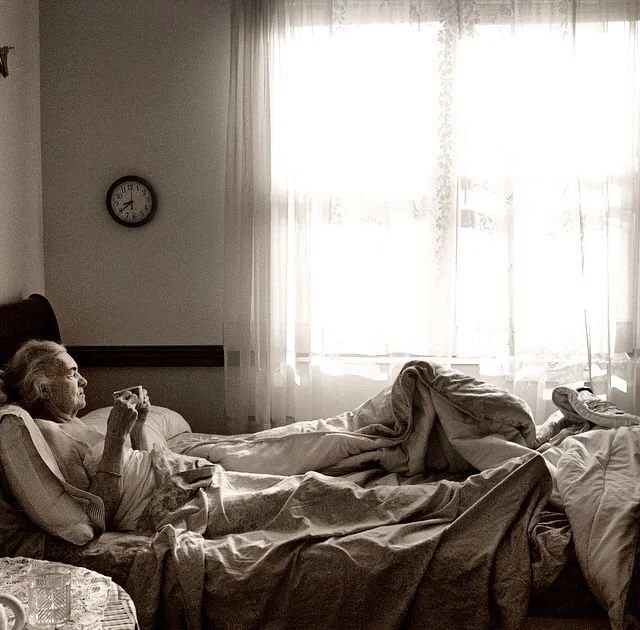
On the last night I saw her alive, she was in her hospice room. The nurses called it the Buttercup Room. The lights were turned low, and it made the walls feel glowy, as if we were wrapped in the petals of a yellow flower.
My daughter, Sarah, was two, and it was her third time seeing her. Though her Mimi wasn’t moving, Sarah wanted to hold her hand. She had brought her Beauty and the Beast music box. When Sarah opened it and the tiny ballerina inside started spinning slowly, tinkly music filled the room, and her Mimi took a sudden, deep breath. She stretched her hands over her head and moved her body, silent, reaching up, toward something, or maybe dancing. Her face looked youthful. It almost looked like she was smiling, but she was silent and still separate from us, already partly in another world.
Blair stayed in the room to sit with his mom while I watched Sarah run up and down the hallways of the hospice. It was the middle of the night. A TV in the corner played the news. Sarah made friends with the nurses. When Blair came out, he asked if I wanted to say goodbye.
I walked into the dim room. A small light at her bedside cast her in gold. She lay still, her sleeping face turned toward me. I sat in the chair beside her bed and took her hand in mine.
“I made you a book,” I whispered stupidly.
It hadn’t come in time. It had all been for nothing.
I took in her golden-gray hair. Her pretty skin.
Slowly, across her face—other images. Her, smiling at a beach house dressed in a royal blue romper. Standing against a banister, smiling with the beloved son she’d lost years before. Then laughing on her grandfather’s shoulders, as a babe with ringlet curls, in a snuggly QVC sweater, chunky rings upon each hand, snuggling her yorkie pups to her cheek.
“I made you a book,” I said again. “I contacted everyone in the family. They sent me photos and stories about you and how much you meant to them.”
And then, as though I were looking at each page in my mind, I recited the book to her. After all that work and fussing and dreaming and longing, all her family’s stories were inside of me, page for page, word for word. I recited them to her breathlessly in the dark. “I know who you are,” I was saying. “I know you lived a beautiful life, and these are ways I will continue to remember you after this. These are stories I’ll pass down to Sarah so she knows you.”
When I finished, it felt like I’d run for miles and miles in my words. She was still. The movements of her hand in mine were probably just me, squeezing, wanting to feel a squeeze back.
I don’t know whether she heard me. But I believe something was healed between us that night. The list had helped me get through those years. The list had kept me enfolded. The storytelling left me open.
Diane is the author of the novel The All-Night Sun (Random House) and Letting Grief Speak: Writing Portals for Life After Loss, a forthcoming craft book on the art of telling our hardest stories. Her short work has been nominated for the Pushcart Prize and honored as a notable essay in Best American Essays 2025. Since 2020, she has led the free online class Grief Writing Sundays. Meet her there or at www.dianezinna.com.