Tanya Friedman
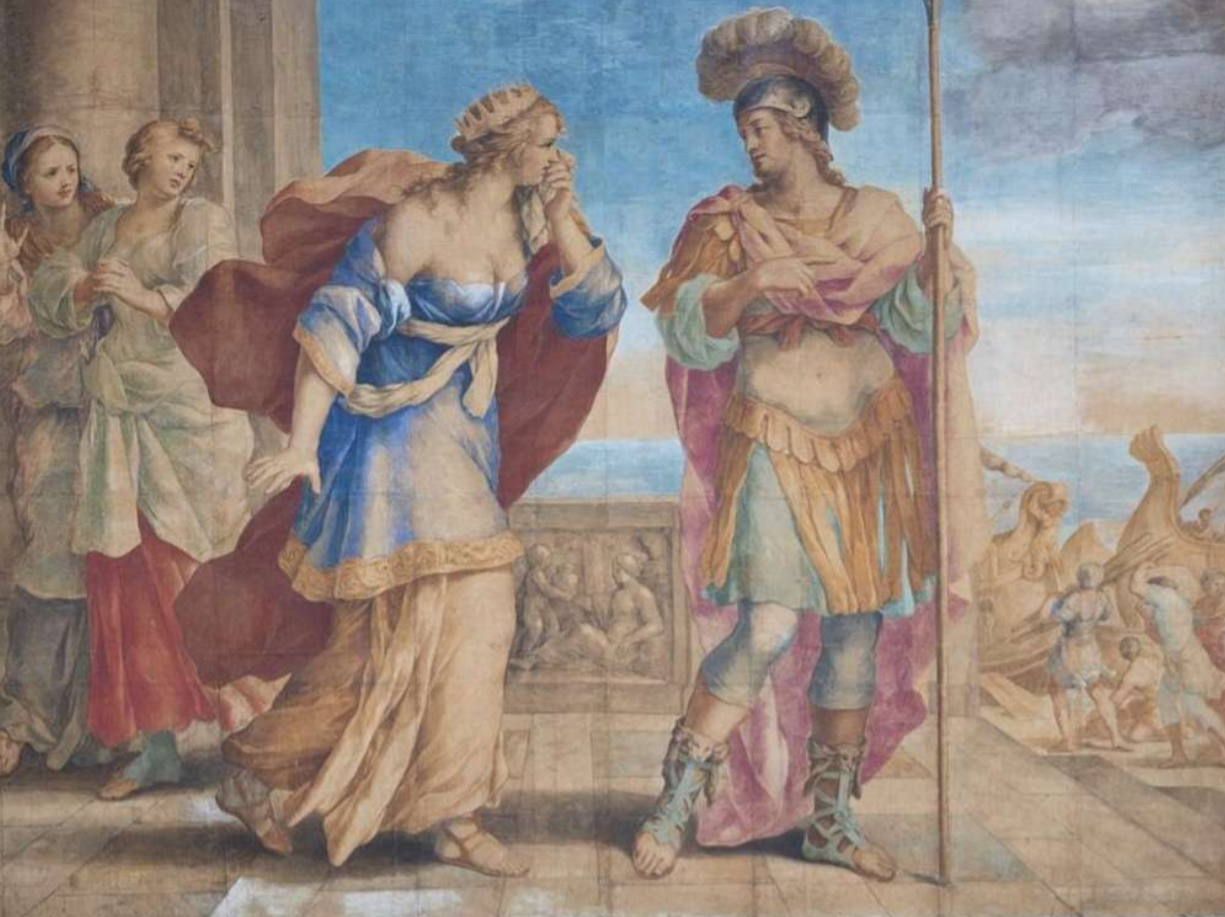
Dido shows Aeneas her Plans for Carthage by Giovanni Francesco Romanelli, 1612
Word Count 857
Catherine and I squeezed our desks together, one book between us. At sixteen, we traveled from elated to distraught at any provocation, and that day Virgil had upset us.
After five years of studying Latin, we finally knew enough to make our way, line by line, through the Aeneid, where Dido had thrown herself on the funeral pyre she tricked her beloved sister into building and, as if that weren’t a sure enough way to die, she was stabbing herself with Aeneas’ own sword.
We translated the words, searched each line for the verb, located the direct object and its string of matching modifiers.
We couldn’t turn the Latin into English fast enough to save Dido, but we tried.
We’d taken Latin together since seventh grade. For most of those years we had a Latin teacher we adored who proved every day that languages weren’t dead or alive but avenues of creation, puzzles of expression, a tool to understand ourselves and the world. We’d fallen in love with Latin but now we had a new teacher, a disappointing guide for Aeneas’ journey. We read her—in her drab clothes and solemn face—as sexless and without passion, and at sixteen we cared only about love and two bodies becoming one. I had a boyfriend away at college and I counted the weeks until we could be naked together. Meanwhile a friend and I kept finding our bodies entwined before promising we wouldn’t anymore.
School offered little. I wanted to discuss love, to debate endlessly who was my real true soulmate while I listened to my friends narrate their own dramas. Except I loved reading the Aeneid, especially now that we’d arrived at Book IV which was, finally, about love not war.
I read phrase by phrase, sentence by sentence, translated the Latin into English. I read on my twin bed at home, on the subway to school, on the floor in front of my locker. The rhythm and meter burrowed into my brain, became the background patter to my teenage hours. I saw Dido’s story everywhere.
“Like A Virgin” came out and Catherine and I knew Madonna had also read the Aeneid.
In the end, after Dido climbed onto the burning pyre, after she cursed Aeneas, after she stabbed herself with the gleaming sword, after her sister begged her to live, Dido tried to speak.
Catherine and I argued with the rest of the class. She tried to sit up three times: proof she wanted to live. If Aeneas had turned his stupid ships around and come back, if dumb, matronly Juno had intervened right then, instead of minutes later when Dido had already breathed her last, Dido could have lived.
“But, what then?” Our Latin teacher asked, in her long black skirt and spinster shoes, her prematurely grey hair pulled out of her eyes with one pink plastic little girl barrette on each side of her face. We thought our angst amused her and chalked that up to her lack of understanding of desire. Her question showed she knew nothing of the kind of love that might make you throw yourself on a pyre, and we were sure this was exactly the kind of love we understood, the only kind of love worth having. “If she were to live, what do you imagine for Dido?”
A fair question.
But we heard only deference to the gods of Ancient Rome, to all the men who interpreted the myths, who maintained that Aeneas had no choice, that he couldn’t buck fate even if he wanted to. Our teenage selves had no patience for this stale argument.
Today I’m more than ten years older than our unloved Latin teacher was and it turns out her forty-two years were not nearly as old as we thought. I wonder now if she was imploring us to invent a new fate for Dido. A life she wished she’d written for herself, or maybe one she had that our immature eyes couldn’t see. What if she wanted us to know the world would insist we choose between power and love, but we could craft a different path?
We blamed Aeneas, wanted him to make a bolder choice, to choose love over fate, but we didn’t consider Dido’s other options. She could have renounced his love, refused to relinquish the city she’d founded, her realm, her reputation. We saw how the story kept Aeneas stuck, but not how the same story limited Dido. Maybe that’s always the way. Maybe none of us can ever fully see our possibilities, whether we’re sixteen or forty-two or fifty-six.
I think of this as I watch my daughter, now sixteen herself, make a new boyfriend the center of her life. I want more to have changed in the forty years since I was her age, in the 3000 years since Dido gave up everything. I suggest she invest her formidable energy in a pursuit beyond her love life. I remind her she could rule the world, make art, create peace. She doesn’t disagree, just shakes her head, certain I’m too old to understand the kind of love she’s after.
Tanya is a queer writer, educator, and researcher who writes about how privilege and empathy inform our inner and outer worlds. Her work has appeared in River Teeth, Atticus Review, and Radical Teacher, among others. She is writing a memoir about how many mistakes she had to make to become an anti-racist grown up and effective teacher (spoiler: a lot).