Beverley Stevens
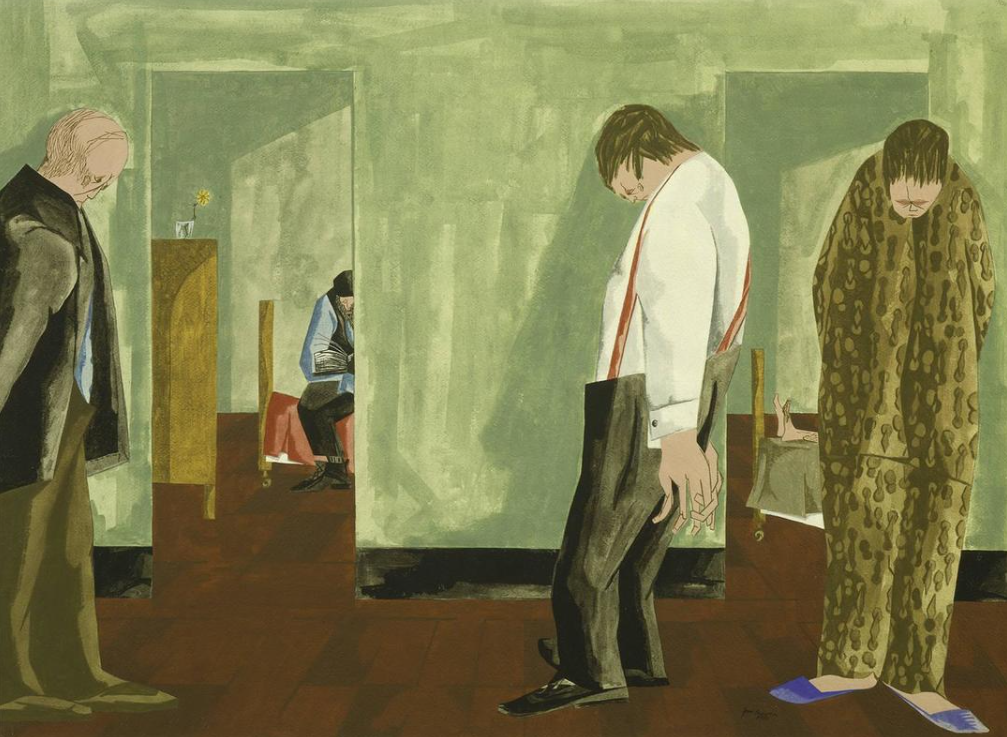
Depression by Jacob Lawrence, 1952
Word Count 503
My shoes tapped along the long echoey lino corridor as I headed for the psycho-geriatric ward that I’d been assigned to. The featureless passageway was empty, no one to be seen until I reached an external door where a young woman was mopping the entrance way. When she looked up to return my greeting we recognised each other. ‘Naomi’, I exclaimed, then ‘What are you doing here?’ It was an old schoolfriend, bright, pretty, full of promise. We’d lost touch when I moved away.
‘I’m a patient', Naomi told me. ‘Heroin addiction.’ We stood just outside on the steps soaking in the spring sun as she sketched the bare bones of her story. She’d run wild, got in with the wrong crowd. A judge had issued a court order sending her here. This was right at the time, I would learn later, that the ‘Mr Asia’ drug syndicate was expanding its heroin operations in New Zealand, as well as bringing in the high-quality Thai Sticks (stronger than locally grown grass), that mellowed our weekends.
So here we both were, Naomi and I, at Carrington Psychiatric Hospital, at the same time, in very different roles. As a junior social worker, I was stumbling through stomach-churning days as I got a taste of life in different wards and other institutions. Induction week had meant visits to view children with frightful elephantine heads who were spending their curtailed lives in cots, a whole row of them in a bleak sunless upstairs ward. It meant a peek through a barred window at the dangerously criminally insane who were held at a nearby facility, and a visit to a Parnell methadone clinic. And it meant a tour of the crumbling, cabbage-reeking, Mt Eden Prison, another menacing Victorian brick edifice not unlike the hospital with its disturbing eruptions of shrieks and shouts, its many locks and the bundle of large keys I carried everywhere I went.
From my very first day on the job when a girl with Down’s syndrome rushed at me to brush my hair to the group sessions with alcoholics; from my efforts to connect with a 13-year-old girl with a deep fear of birds who I drove to school each day until she attacked a teacher, to driving anxiously in unfamiliar pool cars to halfway houses in poorer parts of the city to see how former patients were settling into life outside, to inspections of the rest homes where we placed people who were unable to look after themselves, to weekly ward meetings where the senior psychiatrist scheduled electro-convulsive therapy and discussed lobotomy, I was in a constant wound-up state. All this was far outside of the realms of my experience. I was in a house of horrors, the unexpected leaping out to unnerve me at any moment. Whenever I could, I retreated to my office to write reports. English had, after all, been my best subject at school.
My footsteps were heavy as I walked home at the end of each working day. I was out to right the world from the bottom up, to help lift the most unfortunate. But no one really seemed to get better and our efforts to place them back in the community were thankless, especially when it was against their will. One 90-year old woman objected when I told her that she couldn’t return home to live alone, that I was taking her to a rural rest home. ‘How old are you?’ she asked. ‘Twenty one? What’s a young thing like you doing telling me what to do? What do you know?’ I was stung. Though I was actually twenty two, who was I to be telling her what to do? What did I know? I was just doing what I was bid, a cog in a machine. A few days later, I drove her with her meagre suitcase of clothes to an old villa in the countryside an hour out of town where I delivered her into a shabby room and left her in the hands of a harried private carer.
My school friend came through okay. Her Facebook posts show a woman, now in her seventies, still enviably beautiful. I'm glad she's alright now. But I think back to all the things I didn’t do that day we met at Carrington Hospital. I didn't find out which ward she was in. I didn’t ask if she needed anything. I think she was about to be discharged. But I didn’t ask if she had support from friends and family. And I didn’t see her again.
Beverley is a Kiwi writer from Wellington, New Zealand who's working on a collection of memoir essays. She's been published in Short Reads, Sad Girl Diaries, Dorothy Parker's Ashes, Landfall, Headland, and the Brevity Blog among others. Her website is designit.co.nz