Mother
Julie Mars
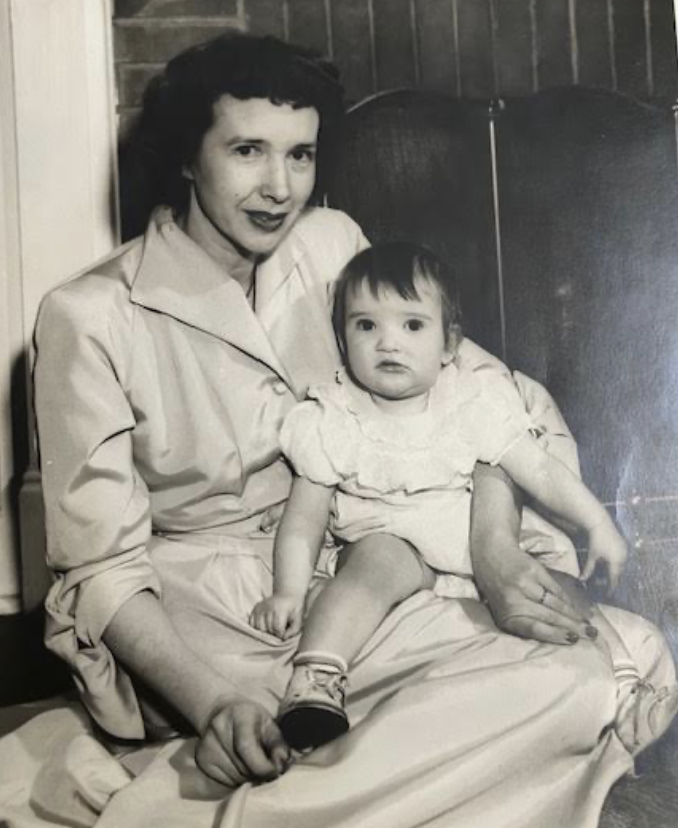
The author with her mother.
Word Count 701
My favorite story is how you had to leave the farm at age thirteen and move into town, into a boarding house, because you wanted to go to high school, and five miles from home was too far to go in a horse-and-buggy. How you had to get a job and found one at the movie theatre.
Usherette. How it was the Golden Age of Hollywood with blondes like Jean Harlow and Mary Pickford and Marlene Dietrich and Mae West. And how, from them, you learned about class and flirting and fashion and all the feminine wiles. And even though you were a hillbilly girl and only had one dress, handmade by your mother, and had to wear it every day to school, you still attracted the attention of the new gym teacher, with his nice shoulders and flat belly, his college education and his two fists, perfect for earning extra money in the boxing ring in the winter and the carnival circuit in the summer, the man nobody could stay in the ring with for thirty seconds. He asked you, point blank, if you could keep your mouth shut about his budding love and lust, and you said, “Try me,” which directly contradicts, perhaps, the answer you gave to the owner of the boarding house when she asked if you were a good little girl. “I try to be,” you said. But then, you were only thirteen, and the new gym teacher would not arrive for a year. Or maybe two.
That’s the end of that story, but not your life. You graduated. You married. You stayed with him seventy years, until death did you part. You raised six daughters. Put homemade meals on the table every day. Wore high heels to iron the curtains and kept your nails polished. You made ends meet, which was daunting with so many daughters who wanted, wanted. When, at age 60, he retired, forced from his job by an old injury, back to the farm you went, back to the house you were raised in, and you lived together in it, 30 more years on a government pension. It was there in that house, when I was visiting decades later, that you said, as you used a tarnished silver spoon to squeeze tea out of a Lipton teabag, “There was not a single day I didn’t think of leaving.”
That night, I couldn’t sleep. It upset me, the idea that you—trapped and unfulfilled—chose to endure instead of run, remain rather than bolt, allow that daily thought of escape to pass you by instead of riding it to wherever gone was. I was always able to read your unhappy undercurrents, though they were never admitted nor discussed. And I felt aware, even as a little girl, that daughters absorb their mother’s unconscious projections, though, of course, I did not express that understanding in those words at the time. But I grew cagey around you, secretive and suspicious. You were my role model in reverse—your capacity to endure, no badge of honor. To me, it meant defeat.
Endurance became my enemy, “Get out” my mantra. I plotted my own life by choosing the opposite of yours at every juncture. Hit the road as a 60s hippy under the name Rose Beef. Chose artists and actors and writers for lovers, and never had a baby. Wandered for a decade—17 countries on next-to-no money. Waited tables in jazz clubs and never arrived home before dawn on work nights. Took drugs, hitchhiked coast to coast, danced topless to “Ball & Chain,” the Janis Joplin version, at parties. Stretched out in a hammock in Mexico reading Sartre and Henry Miller and Colette. I was free, a free spirit, for what it was worth, which at the time was everything.
Still, hearing your words that night, I did not feel good, nor vindicated, nor finally validated. There I was, lying in your parents’ old brass bed, in the house generation after generation after generation had occupied, and what I felt was deep sadness. We lost each other long ago. And even though you endured and I ran the gamut, we never met up anywhere along the way.
Julie is the author of three novels and a memoir. The recipient of a New York Foundation for the Arts grant in screenwriting, a New Jersey Council on the Arts grant in fiction, and a Cone Fellowship, she is a Barnes & Noble “Discover Great New Writers” author, the runner-up for the Independent Press Association’s Memoir of the Year Award (2005), and the 2nd place winner of the D.H. Lawrence Fiction Contest. Her work has appeared in the New York Press, Country Living and Stars magazine, and several newspapers. She currently lives in upstate New York.