Brother’s Keeper
Deborah Meltvedt
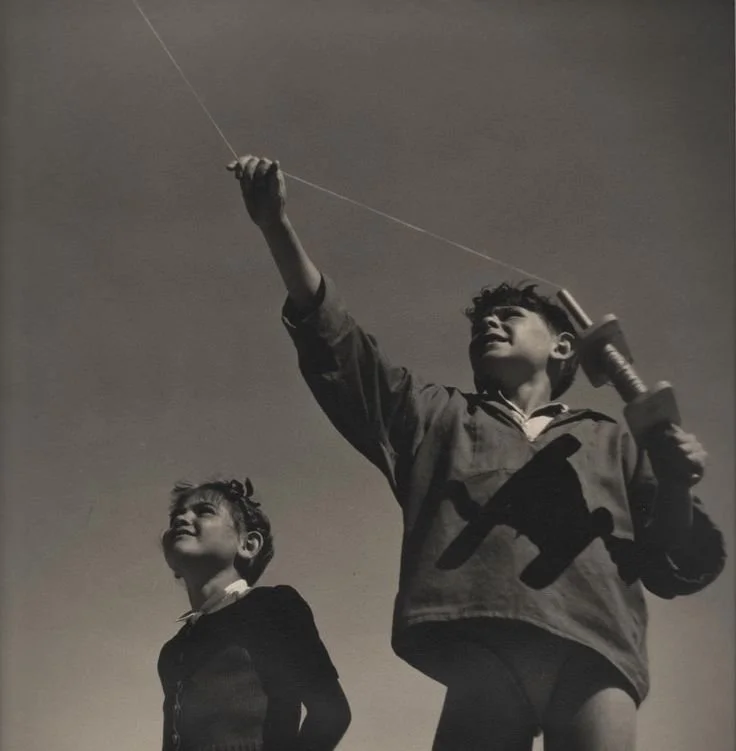
Alfred Planche Le cerf-volant, 1950s
Word Count 1790
The call comes from a hoarse and panicky Eunice. Gary sort of died, then didn’t, then maybe did. After fifteen minutes of CPR, paramedics got Gary’s heart pumping because sometimes DNR rules do not apply when you are trained to keep people alive. Even in Assisted Care. Doctors, after clinical tests on the Brain-Dead scale, got no gag reflex, no blip of thinking, no reflexes. Suddenly, my husband and his one-hundred-year-old mother needed to make a decision. About a brother, about a son.
Why did the mother-in-law bring a notepad to the family dinner?
To take notes on all the ways she can criticize.
I’ve always hated Mother-in-Law Jokes. They are vindictive and mean. And Eunice was neither. But she was a Badass. Even at one hundred and two years old, standing just under five feet, she would wave her arms high to anyone within earshot –waiters, bartenders, Amazon drivers, and later the doctors and nurses at Kaiser Hospital South San Francisco –to debate the injustices of the world. Her outrage ranged from the innocent (why do they keep putting plastic forks in take-out Chinese Food?) to the serious (as a Jewish woman she was still appalled at the murders of Palestinians) to the advisory (“You are never lonely if you have a book nearby.”) Nothing was beyond debate. Curious about humanity’s follies, she could make you defend smoking or running red lights, even when you hated both.
Her arguments were often exhausting, but I loved Eunice’s curiosity and confidence. Her acceptance of me into her family was tender and genuine. Often, when I was near, Eunice would grab my hand and announce how she always wanted a daughter but got two sons. So upset was she after delivering my husband Rick she told the doctor to put him back! Where was her girl?
My husband can joke about his birth story and even brag how he likes to cook and go shoe shopping, but his origin reminds me of the expectations parents have for their children. And the stories they learn to tell. For perhaps the biggest defense Eunice ever gave in her life, was of her first born, Gary. How she had to convince herself, and the world, how good he was at math and sports. How all the neighbor kids loved him. That his brain could be as smart and logical and empathetic as Rick’s, who, Eunice believed, did fine on his own.
Gary was a challenging child. Even in photographs, his eyes looked skyward, his affect blank. Gary had mood swings in kindergarten, depression and delusions by junior high. Finally, in high school, when the “voices” came, Gary was diagnosed with schizophrenia, and my mother-in-law began a campaign to help Gary (and families living with mental illness) get some sort of relief. The house filled with psychiatric journals and psychiatrists’ notes. Eunice joined mental health boards and lobbied for better treatments. And Eunice made sure, hands waving high, that anyone who crossed her path –psychologists, teachers, relatives –knew about the myths of mental illness. Would think twice before telling a joke about “schizoids” or “insanity.”
Medication and therapy, off and on hospitalizations, became Gary’s world. Phone calls to Eunice, sometimes twenty or thirty times a day of inaudible words, then hanging up, became his mother’s daily rituals. But Eunice always picked up.
Rick, though, was never a problem. When Gary wasn’t chosen for childhood teams, Rick excelled as a track athlete. In contrast to Gary’s inability to hold a job, Rick went on to Stanford graduate school and a career in journalism. Rick, as his mother said, was just fine.
Except. His childhood memories are ones of ruined birthdays, not being able to have pets, embarrassing vacations, and later being The Rescuer when feelings of paranoia overcame Gary’s grasp on reality. Illness has a way of making parents choose. Who needs them the most?
*
He is the boy in all of us
who twisted family trees
but now the dark has lifted
and sighs have been set free
Inside the head is logic
it pushes heart aside
and envelopes the best intent
as if we never lied.
The night we got the call. I scribble poetry on hotel napkins but never show Rick. By one a.m. the next day the doctors declare a definite death. It is the day before Christmas eve. The third night of Hanukah. One day after Gary’s heart gave out. Five days after he tested positive for Covid. Minutes after a lifetime of medications and heartbreak.
Rick calls our friends, his cousins, the synagogue, cantor, the people who will take Gary’s TV and his furniture away. Assisted Care needs the room. We are grateful Gary had Kaiser insurance, but Eunice is not allowed at the hospital because Covid loves the elderly. Besides, we think, she has already said goodbye to Gary hundreds of times.
On the morning of the funeral, Eunice points to her head and says I understand up here, then her hands drop to her chest and she adds but not here. She shows me a picture of Gary as a young man. Did I know he had an apartment once? Then adds, even a driver’s license, and once a girlfriend who he took away for a weekend trip at age nineteen. Eunice confides she is glad Gary had a sex life, even if briefly, or so she hopes. We then look out at the full moon hanging in the early morning clear sky. She turns to me and says do you think Gary had something to do with this.
How can you not say “yes?”
The funeral is in Colma, just outside of San Francisco. The home of the dead. A town where there are more dead people than living, where the streets are lined with funeral homes and cemeteries bear witness like auto malls.
We are in the Jewish cemetery. We first lay stones (rocks from Eunice’s yard) on Rick’s dad’s grave. This is a Jewish thing I didn’t know about. Nobody though can tell me why.
The gathering is small. A few cousins, old childhood friends, the Cantor and his wife. Eunice, Rick and I have front row seats on folding chairs that sink a bit into the muddy ground. It’s hard to look down at the view in front of me, the casket that hovers by canvas straps over its new home. On the side, a mound of dirt stands guard. Instead, I focus on the Target sign about a mile away and the dance of large birds that dip in and out of the headstones. Luckily, the Cantor does not go on too long because I want to hear Rick’s speech. Words not about Gary’s false accomplishments, but about the love of others who helped Gary throughout the years. About how much mental illness has changed because of his mother’s devotion and advocacy work.
Eunice’s hand clutches mine throughout the whole service. Until. Right before they lower the casket into the ground, she releases her grip, rises slowly, her feet wobbly in soaked earth, and leans her whole body across the casket and hugs it.
For a moment nobody breathes.
Then Eunice quietly sits back down. And takes my hand again.
*
Forgiveness walks into a bar and sits down quietly. The one who needs to notice is yourself.
Some say mental illness is worse than physical illness. Sometimes people take their own lives or more often than not they don’t eat right, think someone is following them, tape windows shut to keep out hallucinatory horrors. Sometimes a brother helps out of obligation, not love.
Rick sometimes thinks he is a terrible person for not being as kind towards Gary as strangers often are. But the ones who “case-managed” him didn’t grow up in the same room or house or schoolyard or city street as Rick did. We didn’t have to leave work or school or practice or friends to call the police because a brother didn’t take his meds. We didn’t have to peel the aluminum foil from the windowpanes. We didn’t have to lose attention because it all went towards reigning in a big brother. But I know Rick is a good and decent person capable of sacrifice, because, despite a mother’s extra attention to one child, she also raised Rick to be the “daughter” she never had –one who is sensitive, loyal, and, yes, can cook a damn good meal.
*
On the evening of Gary’s funeral, the winds start up again and rain blurs the view of the bay city below. Back home our backyard fence came down in rushing winds. We have insurance. No worries. Eunice asks me why some trees come down in storms and others don’t. This is like her. She draws me in and I try to answer without having a fucking clue. I basically say it has something to do with roots. If they anchor deep into the earth. Or not.
We order Chinese Food and toast Gary with a good Chardonnay. Gradually, as the wine kicks in, Eunice and Rick tell stories. Some involve Gary, but others don’t. That time Rick and his friends took handmade coasters and rode them down the hill towards Mission Street. How proud Rick’s Dad was when Rick got his own column. We drink and laugh. Rick even doodles stories as we talk. There is a new lightness. As if Rick is now the only son, the one who is now noticed. Or maybe it is just that the phone is silent.
*
Recently, we lost Eunice. She was almost one-hundred-and-three and still read two books a week before her heart gave out. I had the privilege of being with both my own mother and Eunice on the day each of them died, eighteen years apart.
The morning after Eunice passed, I heard a rustling in the bushes outside our bedroom window. Squirrels I think, or birds, but it got louder. I glanced outside to see a woman’s thin arm rise from the middle of a bush. I scream and get Rick but when we race outside, nobody is there.
Maybe I had a delusion. Maybe it was a joke by kids next door. But my husband and I tell ourselves it was Eunice. That I get to be the daughter she entrusted to wave goodbye. The one without history. Who understood her as a mother who tried to do her best in a world of judgment where one son needed her more, but where she also loved both. And now I get to be the one to wave my hands high and stand up against mother-in-law jokes. And to realize, sometimes, we are all of us, not always fine.
Deborah is a retired public health teacher and writer in Sacramento, California. Her poems and medical narratives have been published in Creative Nonfiction, Under the Gum Tree, the Intima Journal of Medicine, and Fulcrum Press's Anthology So Heavy a Weight. Her first chapbook of poetry Becoming a Womanwas published in 2022 by The Poetry Box. Deborah lives with her husband Rick and the ghosts of past cats who inevitably show up as cartoons on bar napkins."