With this Ring
Linda Dreeben
Word Count 2034
Art and I had been waiting more than half an hour in Leo Ping’s, the popular, and maybe only, Chinese restaurant in Ann Arbor in the early 1970s, when his mother finally showed up. After sitting down, she handed Art piles of newspaper clippings and letters, and then reached into her near-empty pocketbook, pulled out a small, white box, and handed it to me.
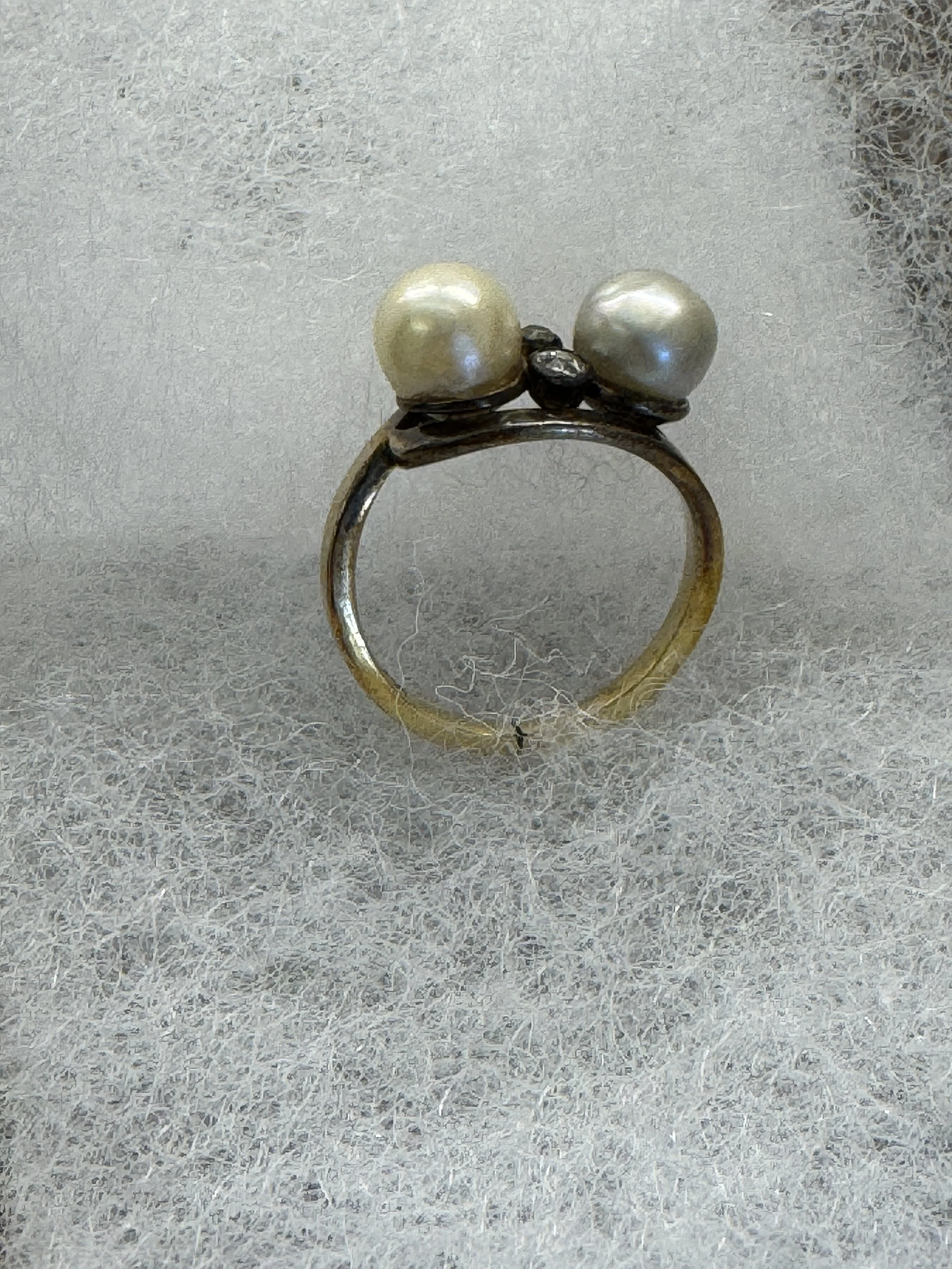
Inside, a ring rested on cotton, like a baby bird in a nest. The band was gold-toned. Two tiny diamonds were placed in between two pearls that sat up like mouse ears. One pearl was white, the other a misshapen, cloudy gray.
“Put it on,” she plucked it from the box.
I slipped the ring on my right ring finger. It was too large, and the pearls rolled into my palm. I turned it upright and anchored my fingers together to keep it in place.
“I had the ring made from a pair of my mother’s earrings,” she said. “I hid them in a knife handle when I left Austria. They were the only things of my mother I could bring. I had to replace one of the pearls, I don’t remember which, when it was lost.”
I returned the ring to its nest and mumbled, “Thank you.” I was 21, getting married within the week and caught off guard, unable to acknowledge the ring’s significance. Later, I said, “It felt like your mother just gave me an engagement ring.”
I met Art’s mother in our sophomore year of college. She was widowed at the beginning of Art’s senior year in high school so we often made the 45-minute drive for holidays. I knew that she’d left Austria at age 22 in late 1939 to escape Nazism, leaving behind her mother, Adele, and her stepfather, who had raised her after her father died. Her 14-year-old half-brother had already left on the Kindertransport to England. She arrived in New York with only what she carried; the Nazis confiscated everything else.
When I first met her, I admired her intelligence and perseverance. She was putting two sons through college and raising Art’s younger brother, all while being active in the ACLU, and had a wide circle of friends. Although she didn’t work until she was widowed, she expressed enlightened views about women’s roles. Criticizing our college newspaper’s request for mothers to send holiday recipes, she wrote, “This project is tainted with male chauvinism from the outset by only asking mothers for recipes.” Not content to offer one recipe, she sent three that would keep “emancipated women” out of the kitchen.
During visits, we looked at photos as she spoke of her family forced to leave Austria and scatter around the world to France, England, Israel, South America, and Australia. She and her brother wrote long letters to each other during and after the war discussing politics, political philosophy, and romances, but did not see each other again until 1960, when her brother visited the U.S. for the first time.
If he was listening, Art would interrupt.
“Mom wanted us to wait at the bottom of the exit ramp off the highway. But she was so overcome that she ran up the highway ramp to meet his car. When Uncle Kurt got to the bottom of the ramp, he said a crazy woman was running up the ramp. He looked around and asked, ‘Where is Esti?’ ‘She’s the crazy lady,’ my father told him.”
The stories of her parents were the most painful.
“My parents wrote letters asking what I was doing to get them out of Austria. Had I called the State Department or found a sponsor?” she recounted. “ I called the Red Cross and Jewish organizations. I could never get them out.”
Ultimately, her parents were murdered in a concentration camp. My prior experience of the Holocaust was reading Anne Frank’s Diary and watching black and white newsreels in Sunday School showing emaciated concentration camp prisoners in stripped uniforms. Art’s mother was the first person I knew whose family and life were so directly shattered by the Holocaust.
I wore the ring on my right hand on our wedding day. I wore it to family celebrations when I thought it might mean something to my mother-in-law if she noticed. It never fit. Mostly, it stayed in its box in my sock drawer.
Over time, the ring became caught in the web of my evolving, conflicting emotions about my mother-in-law. I felt fearful that, like gas molecules, she would expand to fill all available space.
She could be hurtful. During a time when I was struggling, she wanted to visit. My husband explained what I was going through and asked her to stay with her longtime friends who lived nearby. She did, but insinuated, then and later, that we had rejected her.
She described herself as “wanting to have her cake and eat it, too.” She wouldn’t order dessert but wanted to taste everyone else’s, her “tax.”
Her husband had been a social worker, but she eschewed therapy. “My life is depressing. My father died when I was a baby, my parents were murdered, my husband died, my sons abandoned me. Therapy can’t change that.” Instead, she threw shoes at the painted portrait of her husband that hung in the living room.
She turned to her sons to listen to her convoluted travel plans to see every relative, to weep on the phone about how miserable her life was. Art would try to reason with her, to “solve” a problem that she didn’t want solved. Against any good judgment, I was drawn into his side of these conversations.
“Mom, it doesn’t make sense to go to Lyon for a day and back to Paris, just to spend a few hours with Ruth before she leaves on her trip.”
“She knew you were coming and didn’t plan around it.”
“Mom, I hear you want to see her but… Let me finish. Let me finish.”
“This is crazy,” I mouthed, rolling my eyes and gesturing for him to hang up.
“I’m sorry I made you cry.”
Long pause.
“You keep saying the same thing and not listening. Mom, stop. I’m hanging up.” Phone receiver knocking the wall cradle askew.
When the phone rang again, I’d go to our bedroom, cover my head with a pillow and bang my fists on the mattress, resentful of the toll on my husband.
Those draining phone calls, the limit pushing, the sucking up of time like a tornado spawned arguments between my husband and me. She was his mother, he loved her, his tolerance level was much higher than mine. He had grown up working around her erratic emotions. I resented her intrusions, while feeling selfish. I hated putting him in the middle, knowing that he felt guilty if acceded to my view. Then I felt guilty. Compromises we proposed, she rejected.
When she visited, I vowed to take deep breaths, float above like a cloud. Try to appreciate her love of our two sons, gossip about family, insightful opinions on political issues. One visit, as I drove her to a store, she could not stop talking about Art’s older brother’s potential job opportunity.
“Do you even know what Art does?” I exploded. “He’s head of his office and in charge of significant cases.”
A dark cloud raining anger and guilt.
She talked about moving near us. “Mom, it’s a free country and you can move wherever you want,” Art would respond. Once, in jest and perhaps in deference to me, he said that she should plan to live in a different zip code. She told friends, in our presence, that we’d rejected her by forbidding her to live in the same area code.
The move to our area happened when she was 82 in declining health.
One Sunday, a year after the move, during her third hospitalization, she had taken a bad turn overnight. She was weak, unresponsive, her skin bruised, translucent, papery. We moistened her cracked lips with pink sponges. She showed no sign of recognizing our voices or reacting to the pungent body odors in the room.
I smoothed a spoonful of vanilla ice cream, banned from her diet, over her lips, like balm, hoping she could taste the forbidden sweetness. It slid down her chin. After we left, the hospital called to say she had died. My husband burst into tears. I held his head in my hands. After a few minutes, he turned to practical tasks, emailing relatives and friends around the world, arranging to send her body “home” so she could be buried with her husband. I’d believed she would outlive us. She would have her cake and eat it, too.
Several years after she died, when our families were together for Thanksgiving weekend, we poured two bags of her jewelry onto a large coffee table, like a child’s haul of Halloween candy. It was mostly inexpensive jewelry, many of them gifts we all had given to her. The few items of any value, monetary or sentimental—a pearl necklace from her husband, a gold necklace from a close friend—had been claimed. I had the ring, the piece of greatest emotional weight.
“We gave her these.” Art held up a silver feather pin from South Dakota, a glass bead pin from the Czech Republic, one of an alligator holding a baby alligator. “Then she told us to stop giving her pins.” I kept the alligators.
We laughed. I imagined my mother-in-law watching, enjoying that these trinkets had brought us all together; that she was the center of attention again.
In time a patina dulled my resentments. When my sisters-in-law rehashed old grievances, I tried to stay silent, not defending her but not joining in. There were times I felt her absence, when I wished I could ask her a question about a family member, a letter or photo.
I learned about the strength of family connection from her. She acted on her commitment to social justice in a way I had not experienced growing up. She had suffered and lived with losses that never left her and were beyond my ability to grasp. Like the pearl on the ring, she was flawed, but also resilient.
I was widowed 16 years after she died. I now understand the before and the after, the anger and despair at the unfairness, the aloneness that can be all consuming, even as I struggle not to let it devour me. I see her as a cautionary tale.
What to do with the ring? I considered making two rings, one for each son. The marred gray pearl would have been unattractive on its own and replacing it would create one more step removed from Adele’s original earrings, secreted across the ocean to an uncertain life.
I decided to give it to my niece, the only granddaughter. That would keep the ring as a family heirloom. But, as each milestone—her college graduation, her wedding, her 30th birthday—passed, I did not give it to her.
I could not part with it.
It had come to mean family, a connection between past and future. It was an unbreakable link to Adele, in whose memory my husband had been named, and whose life and death forever connect our sons to an outrage beyond comprehension.
***
My granddaughter was born four years after my husband’s death. Following Jewish tradition, her parents honored his memory, naming her Talia Adele. I cried when they told me her name just after her birth. Adele, for the grandfather she will never meet, who was named for a grandmother killed in the Holocaust.
I wore the ring to Talia Adele’s naming ceremony where she received her Hebrew name, Tova Esther, after my mother-in-law. “I hope,” my son said, “that like your great grandmother, you are strong and resilient, care deeply about family and social justice, and appreciate the values in different cultures and ways of life.”
I am thankful my son recognizes his grandmother’s goodness.
After the ceremony, I placed the ring on fresh cotton in a new white box. On it I wrote “For Talia Adele, Tova Esther.” I imagine my granddaughter taking the ring out of the box, trying it on, examining it as her three-year-old hands now touch my earrings as she says, “I like your earrings.”
From generation to generation to generation.
Linda is an attorney living in Maryland. She has published several pieces in Five Minutes 100 Words, and Wild Greens, among other publications. She is grateful to be in a writing group with talented and supportive women.