What Should I Have Called You?
Kate Stone Lombardi
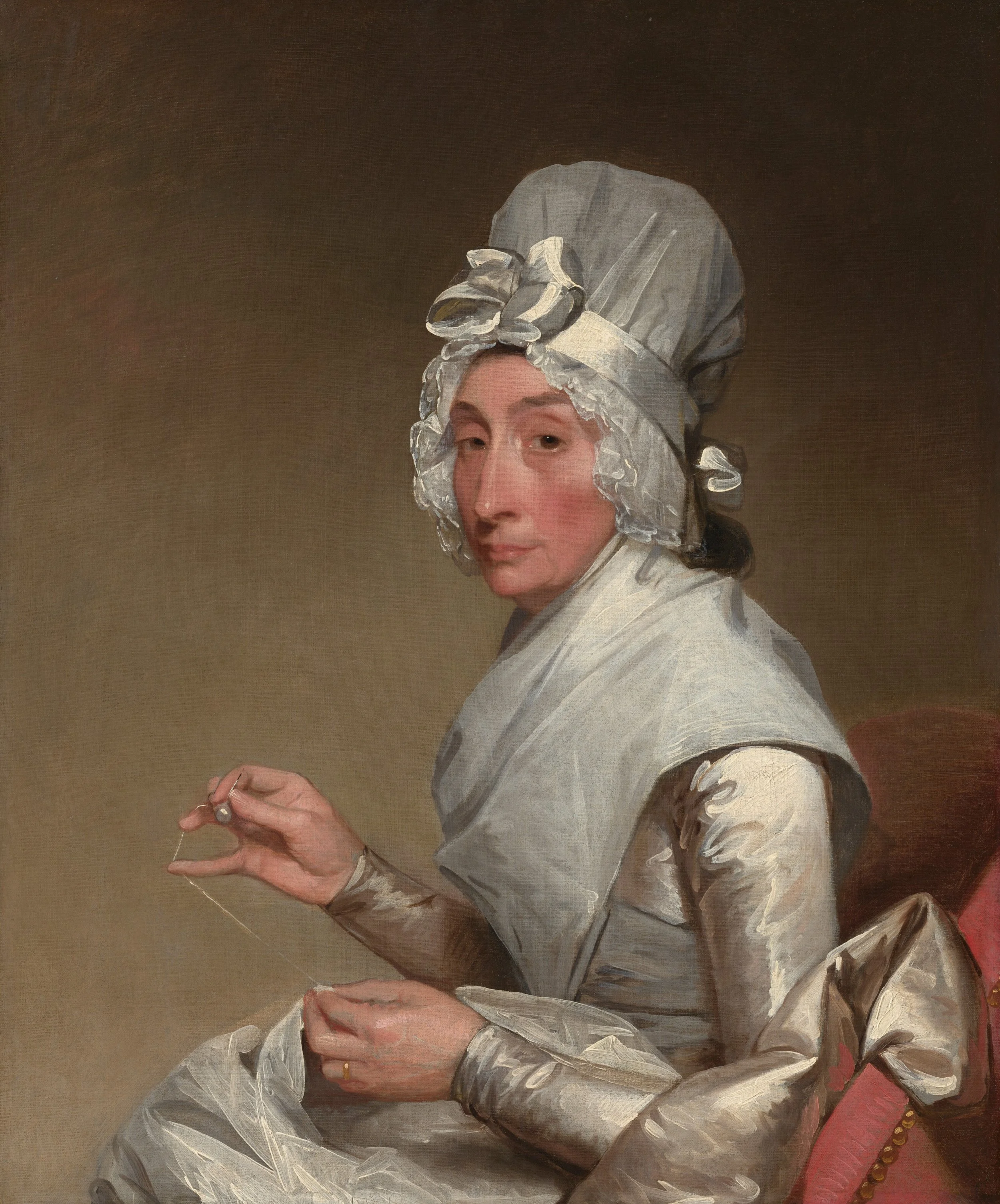
Gilbert Stuart, 1793
Word Count 1503
“You’re divorced,” my boyfriend’s mother pronounced, her face a mask of tragic disappointment.
We’d just sat down at her kitchen table, and this was her opening gambit. We’d met an hour earlier, me bright-eyed and eager to impress. This woman would become my mother-in-law the following year.
“What? No, no, I’m not divorced,” I said, startled. The kitchen was cramped, with one small window over the sink, barely letting in a desultory winter light. My boyfriend, Michael, had decamped to another room to watch football with his father. His dad was fully settled into his Barcalounger, beer in a koozie by the footrest.
My future mother-in-law’s mournful tone continued.
“Oh, you had a broken engagement then,” she said, looking down and shaking her head.
“No, I’ve never been engaged.”
At this point she looked up at me, confused. “But you’re so old,” she said.
I was twenty-five. And baffled. What was she talking about? Michael and I lived in New York City. I’d just finished graduate school. We didn’t have married friends. The idea that I was a spinster in my mid-twenties was ludicrous. I was ramping up my career. Marriage wasn’t on my radar.
Mike’s mother seemed guileless, but I was offended. Why would she say this to me? I couldn’t wrap my head around it at all.
Only now, decades later and long after we buried my mother-in-law, do I understand that in her experience, I was old to still be single. Michael’s grandmother married at sixteen. My mother-in-law also married as a teenager, at nineteen. His younger sister, Marie, had been engaged at seventeen, but ended up marrying a different guy at age nineteen. (Marie’s parents had told her – the one girl in the family - that they would pay for college or a wedding, but not both. Marie, in her teenage wisdom, chose the wedding.)
You’ll notice that I don’t refer to my mother-in-law by name. I never knew what to call her. She never said, “Call me Joan.” I never heard her address her own husband by his first name, just “Dad” or “Honey.” I couldn’t call my mother-in-law “Mom.” Not only didn’t she ask me to, but also, I had a mom. And “Mrs. Lombardi” seemed ridiculous. So, for thirty-eight years, I danced around it.
From the get-go, we didn’t know what to make of each other. I found her baffling and I was a mystery to her.
At that lofty age of twenty-five – and for an embarrassingly long time afterwards - I knew little about the world beyond my own experience. Education was a given, as were women’s rights. Religion … not so much. I’d never given much thought to how class works in this country. The people I’d grown up with in the New York suburbs, gone to school with, and then hung with in the fast-moving Manhattan scene were…well, they were just like me.
My mother-in-law, by contrast, was one of nine children, and smack in the middle of a six girls. Money was tight, college was not a consideration, much less an option. They all went to Catholic school, until Joan, Mike’s mother, was pulled out. Her father said she was too dumb for him to ante up the tuition for parochial school. I don’t know what happened, but it was a stunning little piece of cruelty.
That same father who, on Joan’s wedding day, was found drunk and disheveled on the street by her brother, who’d been dispatched to look for him. Joan’s brother dressed, shaved and produced the old man at the church. The father who in his later years would lay in bed all day, trying to get one of his dozens of grandchildren to go to the liquor store for him and sneak him a bottle.
Yet once, some twenty-five years into my marriage, my mother-in-law sat with me at that same kitchen table and said, “I’ve never known anyone who was an …. how to you say that thing? Al-key-hall-ic?”
I stared at her, incredulous. She herself sipped beer out of a coffee cup, evidently believing that no one noticed.
“Are you serious?” I said, in an unkind voice. She pivoted and changed the subject. Did it even occur to me that this was a subject so painful that she had to dissemble?
Another time she told me that she expected Michael to die as a baby. When I asked why, she said that he was so good, so perfect, that she thought the angels would want him sooner rather than later. I rolled my eyes.
Only now do I realize that she was a young, anxious mother trying the best way she knew how to make sense of her fears.
What did I expect from this woman? She was bullied by her siblings, bullied by her father, bullied by her own mother-in-law and bullied by her husband. She was evasive and indirect, did work-arounds, hid bills, and always expressed deep surprise over the most obvious things.
The greater her childlike behavior, the more annoyed I became. I’d be sharp and confrontational – even show-offy, bragging about my career and our life.
My mother-in-law would counter, never overtly but with jabs.
“Marie is such a good mother,” she told me with a beatific smile. “She doesn’t work.” The implication was clear. When my mother-in-law discovered I had a cleaning service come to our house every other week, she began repeatedly referring to “Katie’s maid.”
She was an anxious and jittery woman, never sitting down for long, jumping up to do something, get something, serve someone. She often hummed something tuneless to herself, sometimes making little clicking noises with her teeth. My mother-in-law never dressed up. She wore sweatpants to her own mother-in-law’s funeral.
One of her more infuriating habits was her inability to accept gifts. We never saw them in use at her house or on her person. We’d buy her thick, fluffy towels, but arrive to the same thread bare ones hanging in the bathroom. We’d buy her warm, soft sweaters, but she sported the same ratty sweatshirts. Sometimes she tried to give presents back. Later, after she died, we found much of what we’d gifted her over the years still pristine and never unpacked from the boxes.
Only now do I understand that she felt unworthy of gifts. My mother-in-law didn’t think she deserved nice things, nor did she think she should spend time or money on herself – not that she had much to spend.
She raised five kids, worked at Sears while her husband held down two different jobs. Every Sunday the kids would be washed, comb marks still in their hair, shoes shined and then marched off to church. Her pleasures were going to the beach, visiting her sisters, and watching football.
My mother-in-law was just trying to get by and live her life.
What a horrible snob I was. What a spoiled brat she must have found me. Why couldn’t I see it at the time, and what would have cost me to show a little compassion?
My final visit to my mother-in-law was in a rehabilitation nursing home. She'd fallen at home and broken a hip – the classic old woman’s demise. She raced through her physical therapy exercises to get them over with, because she had no real interest in recovering. Her husband had died months earlier. She died in the middle of a coughing fit, just before the Covid shutdown. The virus had already been galloping through the facility.
Now I’m a mother-in-law. In some ways, my two kids’ spouses seem unknowable to me too. My daughter-in-law immigrated from Pakistan when she was eight. She comes from a completely different culture and that’s taken adjustment. She’s a lawyer now. She calls me “Mom.”
My son-in-law served as a naval pilot, and his military background is as foreign to me as Southeast Asia. He is reserved, not a big talker, and his family culture is also completely different from my own. He calls me “Kate.”
I love them both. They are wonderful partners to my kids.
But what do they make of me? Both were very quiet in my presence the first few times we met. I can’t remember which one of my kids told me, “Mom, you can be ... a lot.” When I was getting to know my son-in-law, I thought I was being friendly. Later I learned he found my questions intrusive. When my son and his girlfriend got engaged, I started talking grandbabies to my future daughter-in-law. The day they got engaged. Let’s just say it was neither cool nor appreciated. Both my kids’ spouses are warm and loving to me; much more than I deserve, given my own track record.
Of course, my kids have their own mothers-in-laws, and I hope they navigate the relationship with more sensitivity than I did.
I wish I’d extended you a little more grace, Joan, Mom, or whatever name I should have called you. Whatever would have made you feel seen and appreciated.
Kate is a journalist, author and essayist. For 20 years, she was a regular contributor to The New York Times. Kate’s work has also appeared in the Wall Street Journal, Time.com, Good Housekeeping, Readers Digest, AARP’s “The Ethel” and other national publications. She is the author of “THE MAMA’S BOY MYTH” (Avery/Penguin, 2012), a nonfiction book on raising boys.