Escape North
Sallie Reynolds
Word Count 2243
The 1960s, the beginning of the Civil Rights Movement, was a hard time on all fronts. In 1962, right after he got his PhD and his first teaching job, my brilliant, mountain-hillbilly husband shot himself. He was 25. I was 22.
We’d moved to the Midwest from the South because Southern universities, even the famous ones, were still teaching tainted science, history, even philosophy and the arts. We felt so enlightened! My husband had a full scholarship to a Big Ten graduate school, and I’d been accepted as a junior transfer, though I had to retake all my basic courses. My husband said what we were learning now was “the truth.”
Then he was dead, and I was alone with our baby in a strange little town in Iowa.
A kind of brain-freeze set in. Sleep-walking, half-insane, I’d close my eyes, and our little red car would zoom out of the shadows – thump! I’d wake, heart stuttering.
My father and his wife took the baby and me back to their house in Virginia. I don’t remember getting there. I opened my eyes one day and there were two tiny blue candles – my little boy’s second birthday. Small sticky fingers, icing in his hair. Where had the cake and presents come from?
My father, a doctor and a drinker, was a harsh man, a yes-or-no man who didn’t believe in “feelings,” he dealt with facts. He said, “By god, we all look down the gun barrel at one time or another. But we don’t pull the trigger.” He said, “Isn’t it time you got hold of yourself?”
He and my stepmother would leave me alone in the house with the baby, “testing” me. I’d sit in the empty house, trapped in my skin, my arms tightening round my son till he whimpered and wiggled away.
One Sunday, a family friend came by, and finding us alone, took us for Dairy Queen. We sat at an outdoor table and watched the baby put his little mouth over the top of that snowy curl – eyes wide, was he going to cry? I couldn’t remember if he’d ever had an ice-cream cone before. Mine dripped down my hand, into the dirt.
Meanwhile, my father, telephoning the house and not getting an answer, called the cops. “She may’ve killed herself,” he told them, “or hurt the boy.” The cops stormed up just as his friend was bringing us back.
“You’re destroying your father,” my stepmother said, “you have to leave.”
Two days later, Azariah appeared at the back door, like an angel. Az had been my parents’ cook and my refuge, my heart’s mother, from the time I was born until the woman who birthed me died of drink, 15 years later. Here she was on the stoop, little cardboard suitcase with bright decals from exotic places she would never see. She said, “Come on, gal, you and me and this baby got to get on down the midnight road.”
So with Az as my backbone, I went to Durham, two hours away, got a job at a cancer lab, and rented the first house we looked at. It was in a shabby development for hospital workers. White workers – I didn’t think of that, any more than I’d thought of such things when I was growing up. As a child, I’d been blind to the familiar. Now I wasn’t taking in anything.
I could hardly eat or sleep. My bones poked out like sticks. At night I’d wake in a tangle of urine-soaked sheets and Az would help me the way she used to when I was four. In the morning, she’d help me pull myself together and go to work. Sometimes a little late.
But the work was good – each minute, each second, precisely, blessedly, the same. I didn’t have to speak a word. Just peer into the microscope looking for cancer. With each dark, sick cell, I’d think maybe I was doing something useful.
At my father’s house, the baby had stopped talking, too – made no sound at all, except to cry in his sleep. I’d hold him, then put him down and forget him. Literally forget him. Then – heart in throat – remember. But Az was his constant, now. She never forgot him, took him everywhere in his stroller, sang to him, read him the same little cardboard book over and over. What Does the Rooster Say? One sweet early morning, I heard my little Kevin singing er-er-er-er-errrr. King of the barnyard! Later, drinking his milk, he whispered, “Moo!”
Az worked on his vanished potty training, too, dabbling his fingers in water, even making a little turd of breadcrusts for the potty. “Body comes first,” she said. “Get the body to wake up and remember.”
She introduced herself and Kevin to the neighbors. I wouldn’t have recognized them on the street, but she greeted them extra-politely. “You and me,” she said, “we’re the odd ones.” She told them my husband was dead, I was working at the hospital to “do right by the baby.” One of the women asked what my husband died of. Az told her she didn’t remember the name. “Don’t say suicide, sugar,” she warned me. “People hear that, they cross to the other side of the road.”
Bit by bit, a crust of normal formed at our edges. Kevin’s baby laugh was back, his words came in a tumble. At supper, he’d sit on my lap, his fuzzy yellow hair making a halo. I’d eat a bite, he’d eat a bite. Turn, put his hand on my cheek.
I started taking our wash to the laundromat. Not forgetting. Bathing the baby, not walking off. Giving Az a back rub that made her groan with pleasure. Every two weeks, I drove her the 90 miles to her house for a weekend with her friends.
The minute she was out of sight, of course, bugs crawled all over me. I spent the two days hiding indoors, trying to talk to Kevin with a shriveled tongue. At night, after he was asleep, I’d twist myself into a knot.
And we got through it – we were going to make it.
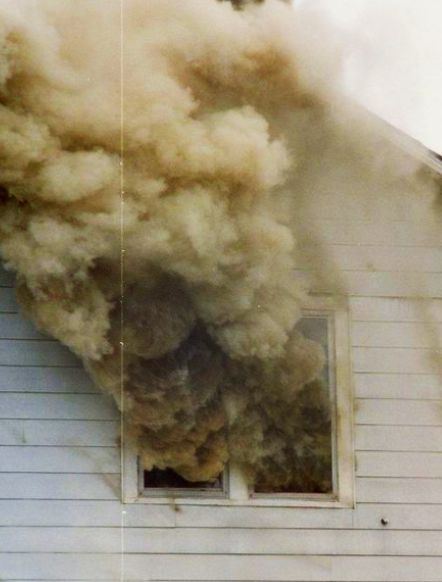
Then one afternoon I came back from work, the street was closed off, fire engines belching and screaming, police sirens wailing. And smoke – thick, stinking clouds of smoke. I dodged the barricade, ran to the house. Something black was smoldering in the wet yard. There were gasoline fumes . . . Az yanked me inside.
One of the neighbor-men, she said, drunk, smashed the kitchen window, leering in – hideous white mask, red rings around the eyes, great red mouth. A clown. He beat on the doors and walls, “Yelling crazy stuff,” she said, “about a white woman living with a —”
“With a what?”
Az shut her eyes and hissed that impermissible word, so vile in the mouth. “Nigga – I’m comin’ for you!” And he banged together some pieces of wood. “Like he was building a coffin,” she said.
A wooden cross. So easy – two pieces of wood, couple of tools, gas and tar for the flash. Clown-Man tossed a match and whomp – flames shot over the roof.
Az grabbed Kevin, ran out the back, over one street, two streets, knocked on a door. “Ma’am, there’s a fire over by our place, I’m looking after this widow-woman’s baby, scared he’ll get hurt.” The lady sat them at her kitchen table, gave Kevin a cookie, called the fire department. When the noise died down, Az thanked her and took Kevin back to the house, to be there when I got home.
Together, she and I, holding hands, watched the fire engines pull away. We waited for the police – praying Clown-Man didn’t get to us first. Under that mask, Az knew him, knew which house was his. I’d never seen her frightened like this. But she was determined to tell what he’d done.
An hour crawled by. Two. The firemen hadn’t even checked on us. Finally I called the police station and a man said, “You ladies didn’t take all that seriously, did you?”
“He broke a window! He lit a fire! My baby was screaming!”
“Nobody got hurt, ma’am,” he said, and hung up.
The houses on either side of us were dark. Was Clown-Man watching? We turned our lights off, too. There wasn’t a sound. What if we fell asleep? The baby did sleep. But for Az and me, every noise ricocheted. The smoke and fumes burnt into our brains.
“Did that man ever bother you before?” I asked.
Sometimes when he was drunk, she said, he’d come pound on the walls.
When I was little, she used to warn me about men like that. Men who felt good if they could make you cry. Scare you. Push you around. But none of that was about me. Nobody except Az talked about those things. Until my university history class, I’d never even heard the word lynching. That happened to people long ago, people who weren’t “like us.”
But this burning cross was us.
By now the street was silent and dark. No TVs, radios, kids playing. No cars driving by.
Az said, “We need to get out of here, sugar.”
We threw stuff in our bags, picked our way through wet scraps of blackened paper, reeking ash. Az, with Kevin wrapped in his blanket, got in the passenger seat of the car. I drove with no lights till we were out of the neighborhood. Two hours later I pulled up at her house.
“We’re good now,” she said.
Everything in me said it wasn’t good. “What if I bring trouble on you here too?” I said. “I’ll find a place for tonight.” She protested. But I said, “I’ll be back tomorrow.
In a motel the next town over, lying on the bed beside Kevin, I began to shake. I shook till my teeth chattered. Kevin twitched, hiccoughing in his sleep. I moved to the floor to keep from waking him. The carpet stank of cheap cleaning fluid and cigarettes. I put my hands over my eyes. Bit my lips. Noises bubbled up.
What could I do? My child was too little to get help if something happened to me. Clown-Man hadn’t cared about him, the police hadn’t cared about him. What if he – woke up alone?
At first light, I called an old friend of my dead husband’s. “My god,” he said, “I’ll get there quick as I can, I’ll bring you up North – you’ll be safe.”
“Oh yes!” I said. “Please, please come get us.”
“If you don’t want to leave,” Az said, “we could move to the good part of town. Where folks like your grandmama live. Some nice widow-lady be glad to rent us part of her house – we could pick ourselves up and go on.”
But what about Clown-Man? What about fire?
I started considering this world I grew up in. Where all the bad was somewhere else, there was a “good part of town” – old white-columned mansions, shaded gardens, chauffeurs. Delicate ladies whose maids brushed their hair, washed and ironed their underwear.
But here was its real face: Grandmother’s maid, last thing in the evening, picking up the dog, carrying him outside to do his business, cleaning up his shit. Az’s sisters nursing my grandmother the last months of her life, because nobody in our family would. Then going home to no electricity or running water. Az cooking every bite we ate, cleaning our house, washing our clothes. She said, to me once, “Nobody knows you like the one who cleans your dirt.” She cut my mother’s toenails, developed corns breaking-in her new shoes. She fed me, bathed me, changed my diapers, tucked me into bed at night, while my mother drowned herself in bourbon. This was the woman my parents gave my care to – a woman they believed was a different species, like a cow or mule. “That godless Darwin at least proved that much,” my grandmother said.
How come I didn’t hear that for what it was?
Had the good people lost their brains somewhere? Didn’t they hear? Didn’t they see?
Oh, yes, they’d recognize my need for Az, all right. But I could never feel normal here again.
“If I got a job up North, would you come with us?” I asked. “You’re a brilliant cook, a genius with people. You could start your own business.”
“Sugar, this here’s my home,” she said. And it was true: friends, family, church – all her history. She couldn’t go. And I couldn’t stay.
My husband’s friend came for Kevin and me, took us North. Helped us in so many kind ways – finding an apartment, even giving me a fancy old car. Kevin went into day care and never lost his speech again. I dyed my hair and bought nice clothes, I studied and worked. But it was a long time before I could sleep through the night.
Years later, on one of my visits to Az, I looked up my father’s friend who’d taken Kevin and me for Dairy Queen. “When you lost your husband and went off,” he said, “you got too Yankee on us. Don’t you reckon you might of imagined that fire? We’re not that way.”
But we are. How does it happen? In our dark places. Inside.
You know the old hymn? On a hill far away, stands an old rugged cross, the emblem of suffering and shame. The same people who build those crosses sing that hymn, harmonize, fill the air with it.
Yes, I’ll cling to that cross, that old rugged cross . . .
And so it burns today.
Sallie is 85, lives back of beyond in Northern California with her painter-writer-mechanic husband, a grand dog, and two hawks (she’s a licensed falconer.) She had to live this long in order to become a decent human being. Her stories are here and there, her two novels are on Amazon.