The Tyranny of Stuff
Amy Welborn
Word Count 1178
“Well, this is depressing,” I muttered.
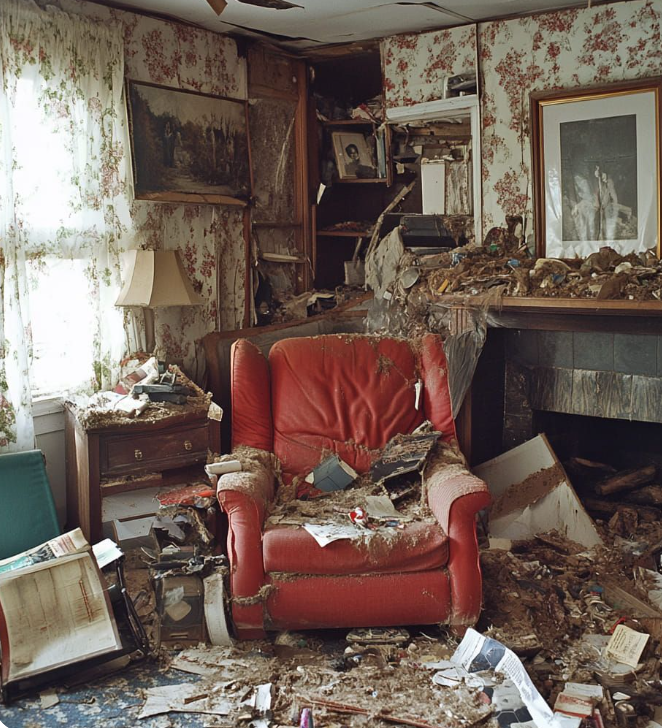
I was standing in an old, filthy, kitchen, in an advanced state of decay, like the rest of the house. There was a guy peering into a cabinet, skeptically.
“To say the least,” he agreed, then turned and walked away.
How could things get to this point? How could this happen?
I’m hot and cold about estate sales. Spying on the shape of other people’s lives appeals to me and there’s always the occasional treasure trove of, say, a table full of Lebanese Catholic statues, medals, and cards in Birmingham, Alabama. The houses are interesting to see, whether for the lux updates in the wealthy sections of town, or the decidedly not-updates, like that Bicentennial wallpapered bathroom.
But then, every time, after a few weeks, it gets to me. I have stuff. Even more, I’ve spent years actually purging stuff as I, an only child, dealt with the deaths of two parents who never purged a thing, and then with the death of my own husband and his stuff. In addition, there were children growing up and moving out (leaving their stuff). As well as my own sense of responsibility not to burden my kids with my stuff when I’m gone.
No, I don’t need more stuff…oh, but what about them? My kids? They’re setting up their homes, I should keep my eye out for cutlery and pots and pans, bookshelves and end tables. So back I go. For their sake, you know.
Until it gets to me again. Not the stuff this time, but the lives spent in these houses, collecting and guarding treasures, even just folding the towels and cleaning the roasting pans that the living now paw through, examine, toss aside or stuff in a bag. So much pleasure and attention poured into those owl collections, those walls of Elvis memorabilia, the shelves of Coke bottles, the dolls, apparently every book ever written about Winston Churchill or, of course, Christmas décor. There’s always a Christmas table and quite often here in the South, an entire Christmas room.
So much energy, so much interest, so much time put into creating the space where we live, and then…we don’t live there. Or anywhere. It’s enough to send me right home gladly empty handed, intent on purging what’s left and determined to reevaluate my priorities.
Last week, after months of not going to any sales – maybe even a year, and not ever thinking about them at all, I saw a sign. They’re always on neon-colored posterboard, the arrows pointing the way. Turn this way, now that, and here you are.
It was a nice day, I had time. Why not?
The wood frame house stood in a neighborhood in which other similar houses of the same era had all been restored, but this one teetered behind bushes and tall grass of an overgrown yard at the top of cracked, uneven concrete steps.
The place was in shambles. I walked through the living and dining rooms, that kitchen, peaked in the back porch, considered the basement – where you can often find the hidden treasures – until a man came up those steps and said to his friend, “You don’t want to go down there. The mold’s really bad.”
Someone had lived here. The foodstuffs in the kitchen weren’t vintage, at least. What had happened? How could it get to this point? I can’t even imagine.
On a shelf in that particularly chaotic attic room, a collection of books on a theme: Writer’s Market 1994. Move on from that, but take note: a cautionary tale.
It was a cluttered, tragic mess. Hoarder? Maybe, although I’ve been to a sale in a hoarder house, and this wasn’t like that is all I’ll say. How could anyone live in this grime, disorder and disrepair? Radical, sudden change – a birth, a death, an explosion, a hurricane – gets all the attention, but it’s gradual change that puzzles me.
In that sad house, I wondered about the change brought about by human action, choice – or failure to choose (which is a choice.) How does it happen that we let life crumble around us? How does idealism turn to bitterness, passion for a person evolve into indifference or even loathing?
I have photos of my mother before she was married, back in Arizona in the 50’s. She’s trim, she’s perched on a ledge on the Grand Canyon, she’s in shorts and a halter top and sunglasses, lounging at a pool next to a dark-complexioned thick-haired man. “Hal,” she told me once. “He was Turkish.”
She looked so happy in those photos. I never knew her that way, not adventurous or casual, not happy.
Change is a scientific thing. In the first episode of Breaking Bad, Walter White rhapsodizes about it, about chemistry, about change: “But that’s all of life, right? It’s the constant, it’s the cycle. It’s solution, dissolution. Just over and over and over. It is growth, then decay, then transformation. It is fascinating, really"
A couple of years ago, I was talking to a friend who’s just a month older than I am. Over some typically great Greek food in Astoria, I asked her the question that had been weighing on me, on the cusp of an age that once seemed ancient to me: “Do you feel fifty-freaking-nine years old?”
“NO!” she exclaimed, clearly relieved to hear someone else say it.
What does it even mean? we wondered, thinking aloud together. What does it mean to be “almost sixty” – but to feel no older than, say, forty.
Alice Neel was an American artist whose portraits of the famous and ordinary folk – and herself – were marked by a kind of unfiltered, almost harsh, but never cruel gaze. She painted a nude self-portrait in her 70’s, sagging breasts and protruding belly and all, a direct challenge to idealized depictions of the human – especially female – form. I often think about something Neel said about this painting that I read in an article a few years ago: “I hate the way I looked … I don’t like my type … my spirit looked nothing like my body.”
When I look in the mirror now, at 66, I see wrinkles and spots and jowls, supposedly me. Me, the same human being who was a baby, a girl carrying a plaid metal lunchbox, a young woman trying to make a go of a marriage that was problematic from the start, who couldn’t imagine giving up, to walking away, to finding someone else, to being a widow, to mothering babies, to surprising my oldest in a Manhattan restaurant on his fortieth birthday.
All of them were me, but the years seem as if they happened to another person and yet – I feel exactly the same. I’ve changed, but I don’t feel it, even though I look it, my spirit feels nothing like my body, and I’m confounded, every time, by the mystery of the change, ever in the midst of it, but never sensing it, never able to explain, really, how I got to this point.
Amy has been writing for over three decades. Her articles have been published in America, Commonweal, The New York Times, Dappled Things and many other periodicals. She's the author of over thirty books on spirituality and faith and one sadly unpublished novel. She has five kids. She writes from Alabama at the moment and can be found at amywelborn.wordrpress.com.